The Tree of Life and the Tree of the Knowledge of Good and Evil
“With a mighty voice he shouted: ‘Fallen! Fallen is Babylon the Great! She has become a dwelling place for demons, a haunt for every impure spirit, and a haunt for every unclean and detestable bird.'”
— Revelation 18:2
Today, we will examine the Tree of Life and the Tree of the Knowledge of Good and Evil, which, according to this interpretation, mark the beginning of the history of religion.
In the book of Genesis, after creating Adam, God placed him in the Garden of Eden—a name that means “paradise.” There, Adam was instructed to cultivate and care for the garden.
At the center of the garden stood the Tree of Life and the Tree of the Knowledge of Good and Evil.
God told Adam that he was free to eat from every tree in the garden except the Tree of the Knowledge of Good and Evil. He warned that if Adam ate its fruit, he would surely die.
Nevertheless, Adam and Eve were deceived by the serpent—understood here as a shepherd used by Satan—and ate the forbidden fruit. As a result, their spirits died.
Scripture records that Adam lived for 930 years. Therefore, when God declared that Adam would surely die, this interpretation understands the warning to refer not to Adam’s physical body, but to his spirit.
Because of this event, God departed from mankind, and as sin increased throughout the world, human lifespans gradually became shorter.
Conversely, if the problem of sin is resolved and God returns to dwell with humanity, human life would likewise be restored and prolonged.
This naturally raises an important question:
What exactly was the fruit of the Tree of the Knowledge of Good and Evil that Adam ate?
About two thousand years ago, Jesus declared that He spoke in parables in order to reveal the mysteries hidden since the creation of the world.
“Jesus spoke all these things to the crowd in parables… so was fulfilled what was spoken through the prophet: ‘I will open my mouth in parables; I will utter things hidden since the creation of the world.'”
— Matthew 13:34–35
According to this understanding, the account of Adam and Eve eating the forbidden fruit contains a hidden spiritual mystery.
Rather than revealing that mystery directly, Jesus explained it through figurative language.
Why did Jesus choose to teach in parables instead of speaking plainly?
One reason is that the Old Testament had already prophesied that the Messiah would teach in parables.
“I will open my mouth with a parable; I will utter hidden things, things from of old.”
— Psalm 78:2
Another reason was to conceal these mysteries from those who opposed Him.
“To those on the outside everything is said in parables, so that ‘they may be ever seeing but never perceiving, and ever hearing but never understanding…'”
— Mark 4:10–12
Let us now consider how Jesus revealed the events of Genesis through figurative language.
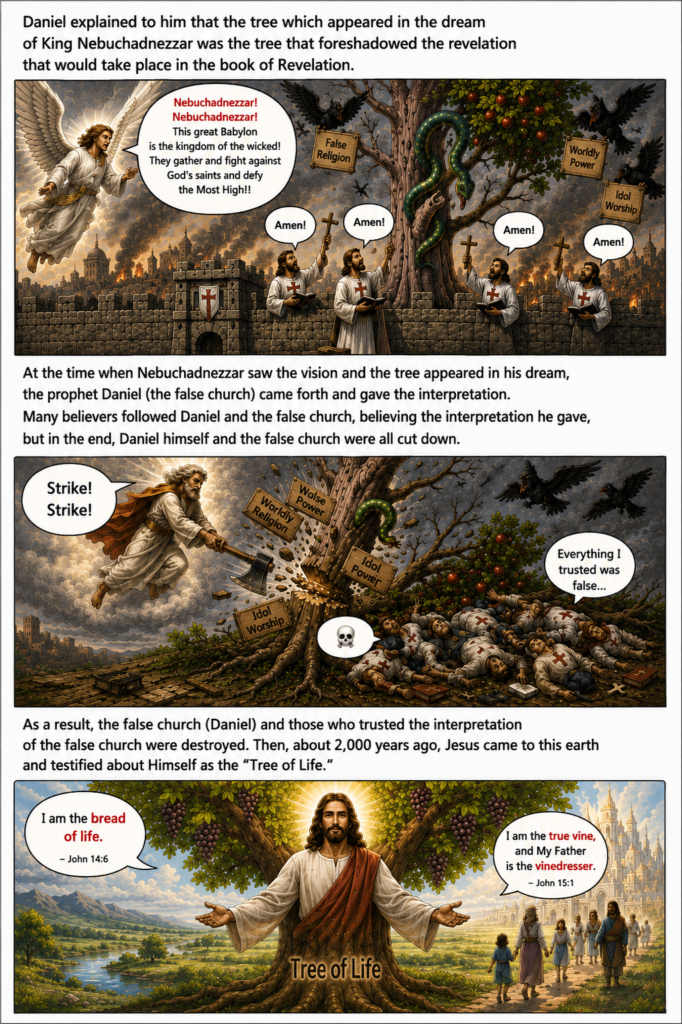
According to this interpretation, Jesus Himself came into the world as the Tree of Life.
“Jesus answered, ‘I am the way and the truth and the life. No one comes to the Father except through Me.'”
— John 14:6
“I am the true vine, and My Father is the gardener.”
— John 15:1
As these passages indicate, Jesus is both life and the vine (tree).
When these two truths are considered together, Jesus is understood to be the Tree of Life.
Just as Scripture teaches that God’s Word has corresponding passages that illuminate one another, these verses are presented together to reveal this meaning.
Furthermore, the words of truth that came from Jesus are understood to be the fruit of the Tree of Life.
“The words I have spoken to you—they are full of the Spirit and life.”
— John 6:63
The Tree of Life does not appear only in Genesis.
It also appears in the Book of Revelation, which records the events of the last days.
For this reason, the events described in Genesis are understood to be directly related to those living in the present age.
The Tree of Life in Revelation and the Beginning of the Tree of the Knowledge of Good and Evil
The Tree of Life appears not only in Genesis but also in the Book of Revelation.
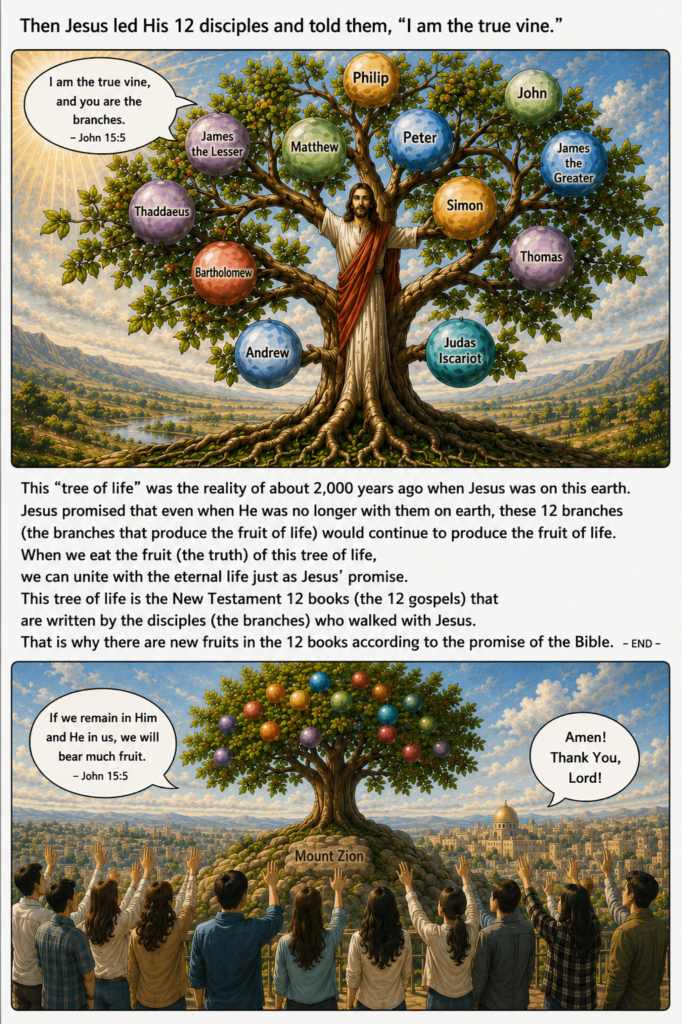
“Then the angel showed me the river of the water of life, as clear as crystal, flowing from the throne of God and of the Lamb down the middle of the great street of the city. On each side of the river stood the Tree of Life, bearing twelve crops of fruit, yielding its fruit every month. And the leaves of the tree are for the healing of the nations.”
— Revelation 22:1–2
According to this interpretation, just as people were gathered through Jesus and His twelve disciples at His first coming, the Tree of Life in Revelation likewise bears twelve kinds of fruit every month at Christ’s second coming.
This is understood to symbolize the twelve tribes that appear in the last days.
Having considered the Tree of Life, let us now turn to the Tree of the Knowledge of Good and Evil, which, according to this understanding, became the source through which sin entered the human race.
“I make known the end from the beginning, from ancient times, what is still to come. I say, ‘My purpose will stand, and I will do all that I please.'”
— Isaiah 46:10
In this passage, God declares that He reveals the end from the beginning.
According to this interpretation, this means that the account of Adam and Eve eating the forbidden fruit in Genesis and the events recorded in the Book of Revelation are fundamentally the same pattern, revealed at different points in redemptive history.
The difference is that the Book of Revelation records these events largely through figurative language, which is why many people do not recognize the connection.
Just as Isaiah says that God declared the end from the beginning, the Tree of Life, which first appeared in Genesis, also appears again in Revelation.
If that is true, then it would naturally follow that the Tree of the Knowledge of Good and Evil should also appear in Revelation.
However, if one reads through the Book of Revelation, there is no direct mention of such a tree.
Does this mean that God’s declaration is untrue?
According to this interpretation, the answer is no.
Instead, it is understood that Babylon, described throughout the Book of Revelation, symbolizes the Tree of the Knowledge of Good and Evil.
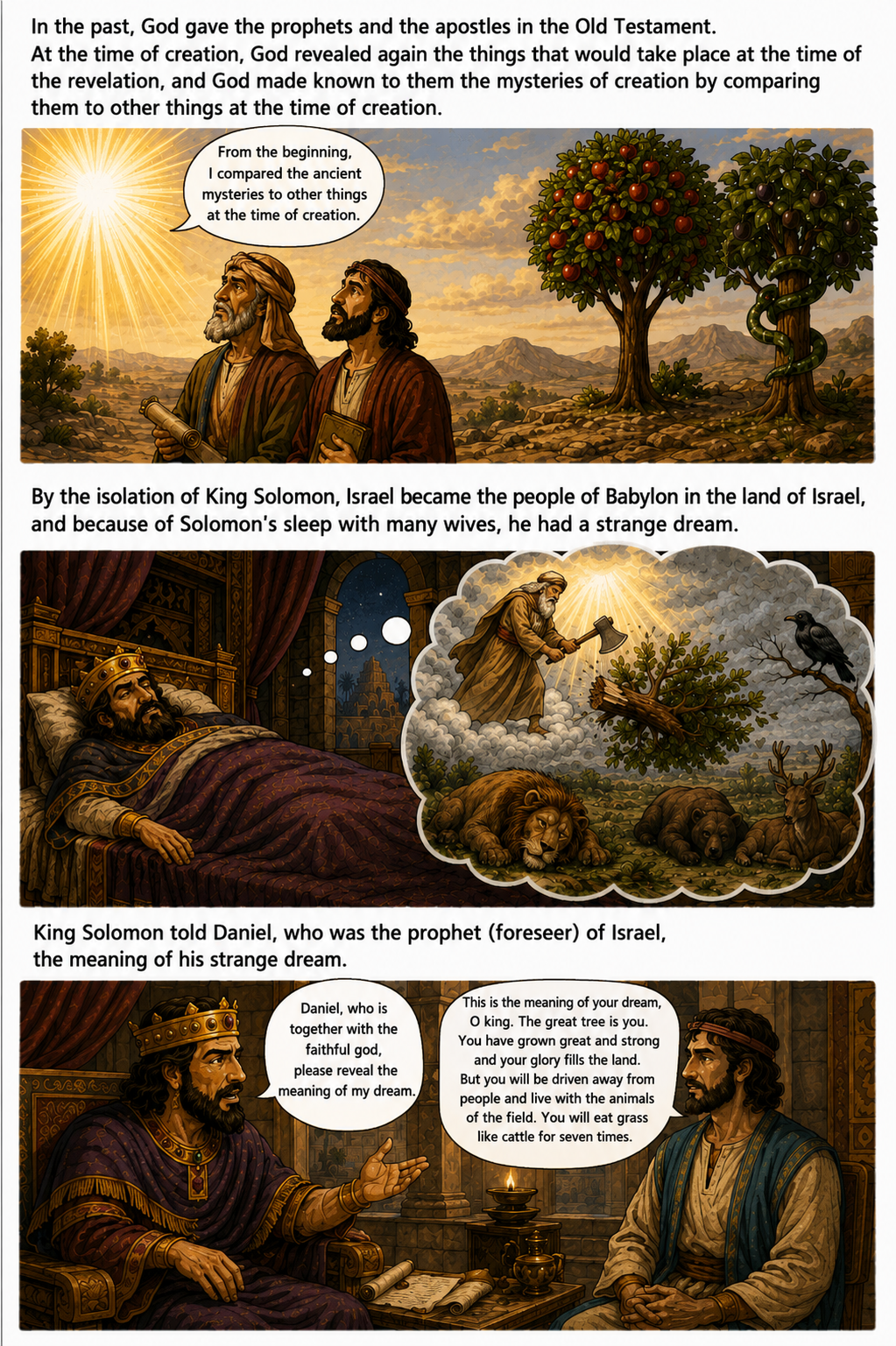
During the Old Testament period, King Solomon turned away from God and worshiped foreign gods.
As a result, the people of Israel were eventually taken captive by Babylon and lived in exile for seventy years.
During that time, King Nebuchadnezzar of Babylon received a remarkable dream.
He described what he saw as follows:
“These are the visions I saw while lying in bed: I looked, and there before me stood a tree in the middle of the land. Its height was enormous. The tree grew large and strong and its top touched the sky; it was visible to the ends of the earth. Its leaves were beautiful, its fruit abundant, and on it was food for all. Under it the wild animals found shelter, and the birds lived in its branches; from it every creature was fed.”
— Daniel 4:10–12
Notice that Nebuchadnezzar saw a tree standing in the middle of the earth.
Likewise, in Genesis, the Tree of the Knowledge of Good and Evil stood in the middle of the Garden of Eden.
Later, the prophet Daniel interpreted Nebuchadnezzar’s dream and explained the meaning of the tree.
Babylon and the Tree of the Knowledge of Good and Evil
The prophet Daniel interpreted King Nebuchadnezzar’s dream as follows:
“Your Majesty, you are that tree! You have become great and strong; your greatness has grown until it reaches the sky, and your dominion extends to distant parts of the earth.”
— Daniel 4:22
According to Daniel’s interpretation, the tree represented King Nebuchadnezzar himself, the ruler of Babylon.
From this perspective, the following symbolic relationship is understood:
The Tree of the Knowledge of Good and Evil = The King of Babylon
For this reason, according to this interpretation, the Book of Revelation uses Babylon as a figurative expression for the Tree of the Knowledge of Good and Evil.
In other words, Babylon, which symbolizes the Tree of the Knowledge of Good and Evil, is understood to appear once again in the last days.
Therefore, the events recorded in Genesis (the beginning) and those recorded in Revelation (the end) are viewed as describing the same spiritual pattern.
This brings us to another important question:
What, then, was the forbidden fruit that caused Adam to die?
Just as the Tree of Life bears the fruit of life, the Tree of the Knowledge of Good and Evil also bears its own fruit.
As explained earlier, during Christ’s first coming:
- The Tree of Life was Jesus Christ.
- The fruit of the Tree of Life was the words of truth spoken by Jesus.
What, then, was the Tree of the Knowledge of Good and Evil?
According to this interpretation, during Jesus’ earthly ministry, the scribes and Pharisees—the religious leaders of Judaism—fulfilled that role.
The fruit produced by that tree was the falsehoods that came from their mouths: teachings that were contrary to the truth, or false doctrine.
Jesus said:
“You belong to your father, the devil, and you want to carry out your father’s desires. He was a murderer from the beginning, not holding to the truth, for there is no truth in him. When he lies, he speaks his native language, for he is a liar and the father of lies. Yet because I tell the truth, you do not believe Me.”
— John 8:44–45
According to this understanding, the religious leaders rejected the truth spoken by Jesus and instead spread teachings that opposed it.
Thus, their false teaching is understood to correspond to the forbidden fruit of the Tree of the Knowledge of Good and Evil.
The Fruit of the Tree of the Knowledge of Good and Evil and the Final Exhortation
According to this interpretation, Christians who are waiting for the Second Coming of Christ must not receive the fruit of the Tree of the Knowledge of Good and Evil that Babylon offers.
In the Book of Revelation, this fruit is described figuratively as “the wine of her adulteries (fornication).”
Just as Adam accepted the forbidden fruit and suffered spiritual death, believers are urged not to receive this symbolic fruit in the last days.
The most important issue, therefore, is to recognize the Tree of Life and the Tree of the Knowledge of Good and Evil as they appear at Christ’s Second Coming, together with the spiritual food that each provides.
Each person must examine for himself or herself:
“Am I in Babylon, represented here as the Tree of the Knowledge of Good and Evil, or am I among the Twelve Tribes, represented here as the Tree of Life?”
According to this understanding, the name Babylon means “confusion of language.”
Spiritually, this is understood to signify confused and mixed doctrines.
During Jesus’ first coming, many religious groups and teachings existed, yet Jesus alone possessed the truth.
Likewise, according to this interpretation, although many denominations and doctrines exist today as believers await Christ’s return, only one overcomer possesses the complete truth.
This understanding is based on passages such as Revelation 10 and Revelation 22:16.
Therefore, those who do not yet understand the Book of Revelation are encouraged to seek out this overcomer and learn the truth from him.
Scripture also warns:
“If anyone adds anything to them, God will add to that person the plagues described in this scroll. And if anyone takes words away from this scroll of prophecy, God will take away from that person any share in the tree of life and in the Holy City.”
— Revelation 22:18–19
According to this interpretation, those who desire to avoid judgment and receive the blessing of the Kingdom of Heaven should study God’s Word diligently and refrain from adding to or taking away from the Book of Revelation.
Only by understanding and keeping its message, it is concluded, can believers remain faithful to God’s revealed will.