God Who Fulfills His Promises
“I have told you now before it happens, so that when it does happen you will believe.”
— John 14:29
These words were spoken by Jesus to His disciples shortly before His crucifixion. In many ways, they may be regarded as His final instructions before His death.
When Jesus said, “I have told you now before it happens,” He was referring to the prophecies He had spoken. In Scripture, prophecy is understood as God’s promise concerning what will take place in the future.
The Old Testament contains God’s promise, delivered through the prophets, that the Messiah would come into the world. The New Testament, through the Apostle John—one of Jesus’ twelve disciples—contains God’s promise that Christ will come again.
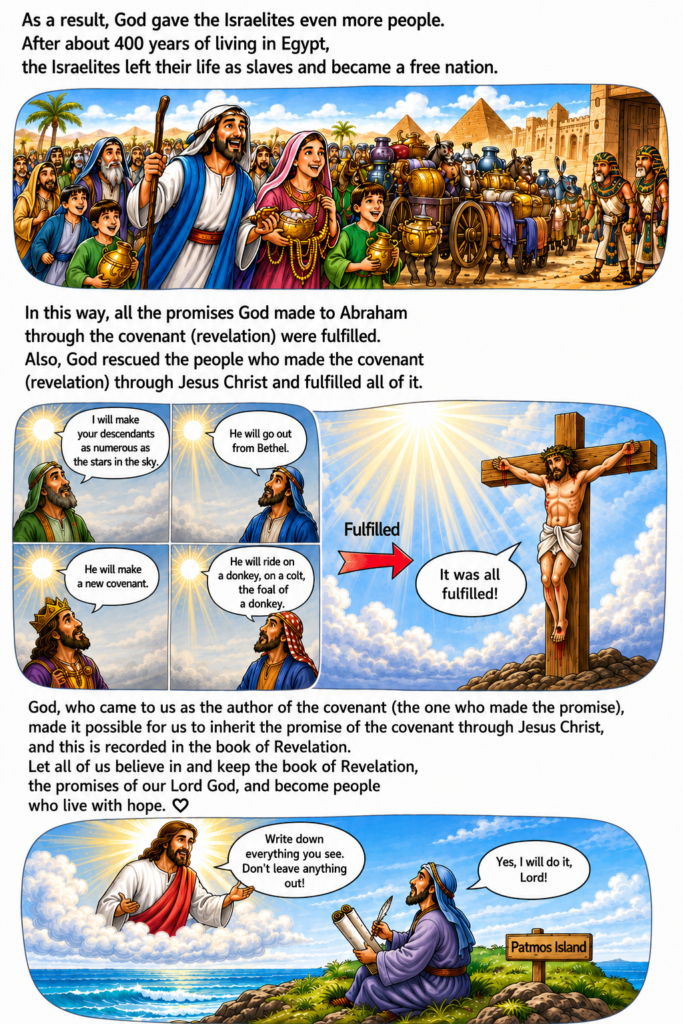
The prophecies of the Old Testament were fulfilled through Jesus Christ. As Jesus declared on the cross,
“It is finished.”
— John 19:30
The prophecies of the New Testament, however, remain to be fulfilled.
The central promise of the Old Testament was that God would send the Savior for Israel. Yet when Jesus came the first time, many of the Jews—the physical nation of Israel—did not receive Him.
“He came to that which was His own, but His own did not receive Him.”
— John 1:11
Approximately two thousand years ago, after His crucifixion and resurrection, Jesus appeared to His disciple John while he was exiled on the island of Patmos and revealed events that were yet to come.
John recorded these revelations in the book we now know as the Book of Revelation.
According to this interpretation, the prophecy Jesus referred to in John 14:29 ultimately points to the prophecies recorded in the Book of Revelation.
Therefore, it is understood that one must understand the meaning of Revelation in order to believe, and that faith in its fulfillment is essential for salvation.
However, the Book of Revelation was written largely in figurative language, making it one of the most difficult books of the Bible to understand.
Over the centuries, many pastors and teachers have interpreted Revelation according to their own opinions and personal views. As a result, many Christians have become confused about which interpretation should be trusted.
So how can we determine whether a particular interpretation is true or false?
According to this understanding, every interpretation must be accompanied by its corresponding fulfillment in reality.
An interpretation that has no actual fulfillment is regarded as false testimony.
It is compared to the tree of the knowledge of good and evil, which represents false doctrine.
Furthermore, it is not sufficient to explain only isolated passages or claim partial fulfillments.
Rather, a valid interpretation must consistently explain the entire Book of Revelation, together with the complete reality in which its prophecies have been fulfilled.
To illustrate this principle, let us consider one example.
The Number 666 and the Need for True Fulfillment
Let us now consider the following passage.
“It also forced all people, great and small, rich and poor, free and slave, to receive a mark on their right hands or on their foreheads, so that they could not buy or sell unless they had the mark, which is the name of the beast or the number of its name. This calls for wisdom. Let the person who has insight calculate the number of the beast, for it is the number of a man. That number is 666.”
— Revelation 13:16–18
Some time ago, I watched a television program in which a pastor explained the mark of 666 as a barcode. He further claimed that the beast mentioned in this passage referred to a machine.
In other words, he presented both his interpretation of the prophecy and what he believed to be its fulfillment.
However, the passage itself clearly states that “the number of the beast… is the number of a man.”
According to this interpretation, this means that the beast represents a person, not a machine.
If an interpretation is supported only by a partial or incomplete fulfillment, it is difficult to determine whether it is true or false.
According to Scripture, human beings are sometimes described figuratively as beasts.
“Surely I am more stupid than any man, and I do not have the understanding of a human being.”
— Proverbs 30:2–3
Based on this understanding, the beast described in the Book of Revelation refers to a person.
Therefore, interpreting the beast as a machine is regarded as false testimony, because such an interpretation is not supported by the biblical text itself.
According to this view, no matter how famous or influential a pastor may be, if he bears false witness concerning God’s Word, he is still a false shepherd.
For this reason, the prophecies of Scripture should not be judged on the basis of isolated interpretations or partial fulfillments.
Instead, the entire Book of Revelation must be interpreted consistently, and each interpretation must be confirmed by the corresponding fulfillment of its prophecies.
Only then, according to this understanding, can one properly determine whether a particular interpretation is true or false.
The Importance of Receiving the Testimony of Fulfillment
The most important reason for receiving the testimony concerning the fulfillment of the New Testament—especially the Book of Revelation—is that Scripture warns of the consequences of adding to or taking away from its words.
“I warn everyone who hears the words of the prophecy of this scroll: If anyone adds anything to them, God will add to that person the plagues described in this scroll. And if anyone takes words away from this scroll of prophecy, God will take away from that person any share in the tree of life and in the Holy City, which are described in this scroll.”
— Revelation 22:18–19
According to this interpretation, believers must receive testimony concerning the realities in which the prophecies of the New Testament have been fulfilled. Only then can they recognize, “This is how the prophecies of Scripture have been fulfilled,” and come to believe. By believing in this fulfillment, they are understood to keep their promise with Jesus and receive salvation.
God has clearly declared that those who add to or take away from the Book of Revelation will not inherit the Kingdom of Heaven, but instead will receive judgment. Therefore, according to this view, it is not enough for someone simply to say, “I believed in Jesus and lived a life of faith, so I will surely enter heaven,” if they have altered the message of Revelation. Such confidence would be based only on personal assumption rather than on God’s standard.
According to this understanding:
- To add to Revelation means to interpret its prophecies according to one’s own ideas rather than according to their true fulfillment.
- To take away from Revelation means to ignore its words or fail to keep what it teaches.
From this perspective, it is concluded that many believers today have, knowingly or unknowingly, added to or taken away from the Book of Revelation.
Those who wish to understand the meaning and fulfillment of Revelation without adding to or subtracting from its message are invited to study at the Zion Christian Mission Center.
According to this view, through such study one can come to understand not only the Book of Revelation, but also the Four Gospels and the Bible as a whole.
Thank you.