The Tabernacle in the Time of Moses
“They serve at a sanctuary that is a copy and shadow of what is in heaven. This is why Moses was warned when he was about to build the tabernacle: ‘See to it that you make everything according to the pattern shown you on the mountain.'”
— Hebrews 8:5
“This is an illustration for the present time, indicating that the gifts and sacrifices being offered were not able to clear the conscience of the worshiper. They are only a matter of food and drink and various ceremonial washings—external regulations applying until the time of the new order.”
— Hebrews 9:9–10
Today’s lesson may be a little difficult, so I encourage you to read it slowly and carefully.
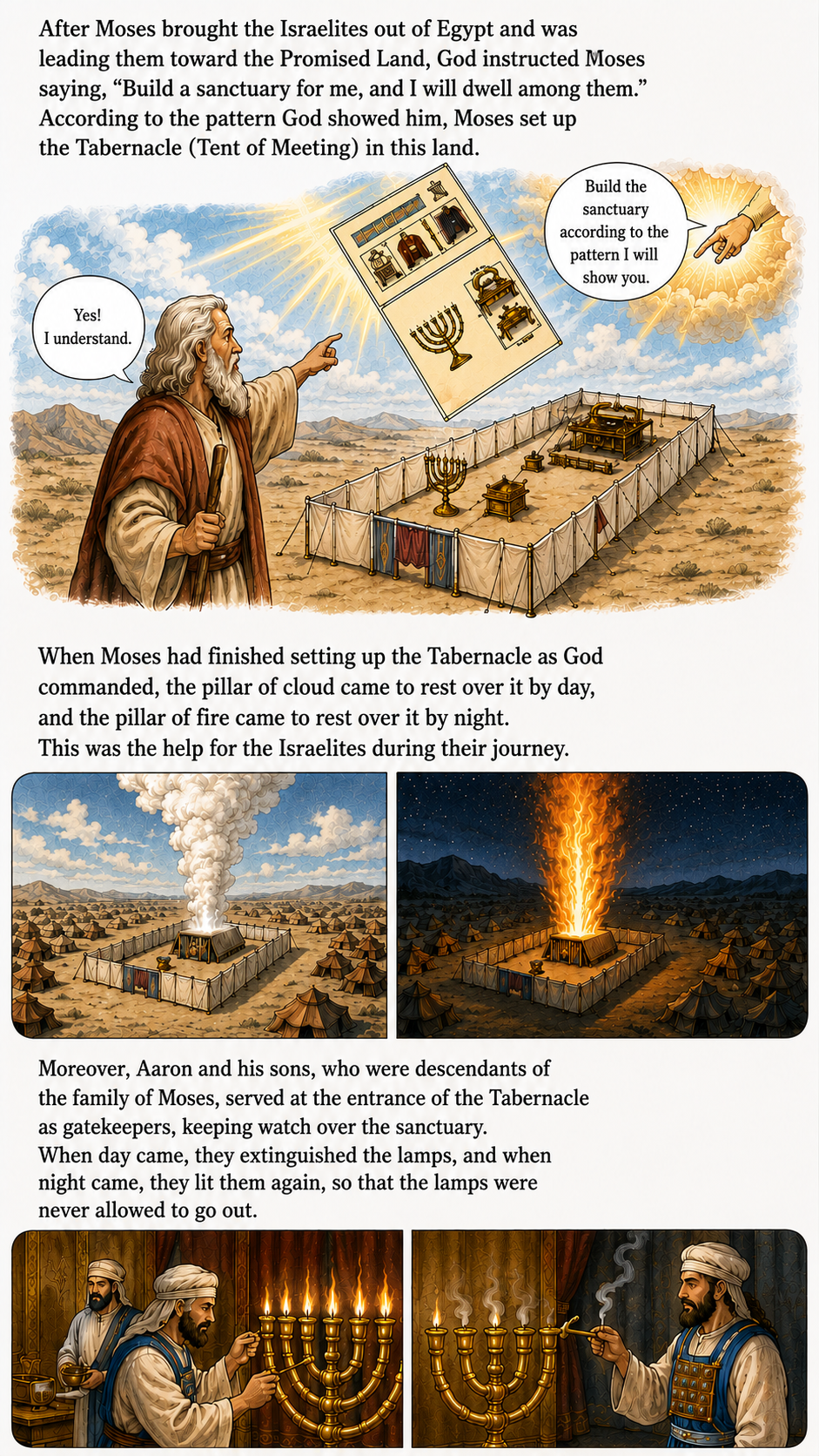
When Moses led the Israelites out of Egypt, God showed him the heavenly pattern of the tabernacle on the mountain (Exodus 25:8–9). Following that heavenly pattern, Moses built a tabernacle on earth. This tabernacle served as the sanctuary where the Israelites offered sacrifices to God and received the forgiveness of sins. In today’s terms, it functioned much like a church.
In the passage above, the Apostle Paul explains that the tabernacle built by Moses was not the ultimate reality itself, but rather a copy and a shadow of heavenly things. If it was a shadow, then there must also be a true reality that casts that shadow.
Paul further explains that this tabernacle was an illustration (or figurative representation) that remained in effect until the time of Christ’s first coming. In other words, the expressions “copy and shadow” and “illustration” convey the same idea. Simply put, the tabernacle built by Moses concealed a spiritual mystery.
Today we will examine that hidden mystery. I hope this study will help deepen your understanding of the Bible.
“Now the first covenant had regulations for worship and also an earthly sanctuary. A tabernacle was set up. In its first room were the lampstand, the table and the bread of the Presence; this was called the Holy Place. Behind the second curtain was a room called the Most Holy Place, which had the golden altar of incense and the gold-covered Ark of the Covenant. This ark contained the gold jar of manna, Aaron’s staff that had budded, and the stone tablets of the covenant. Above the ark were the cherubim of the Glory, overshadowing the atonement cover. But we cannot discuss these things in detail now.”
— Hebrews 9:1–5
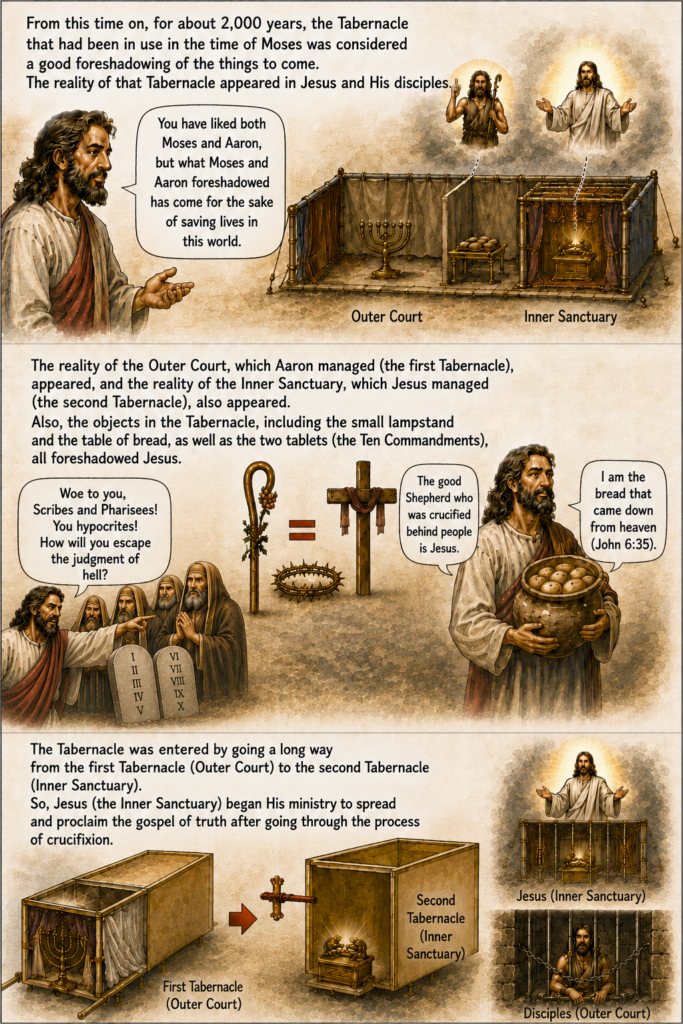
The Apostle Paul, one of Jesus’ disciples, describes the interior of the tabernacle that Moses built. The structure may be illustrated as shown below.
From this point on, let us examine the true reality foreshadowed by the first tabernacle and the second tabernacle, which were hidden in figurative form.
The First Tabernacle (The Holy Place)
The term Holy Place literally means “the holy place.” Since God is holy, the place where God dwells is called the Holy Place.
Inside the first tabernacle built by Moses were the golden lampstand and the table of the Bread of the Presence (also called the showbread). As Hebrews explains, these furnishings were themselves symbolic, and their true fulfillment appeared at the time of Christ’s first coming.
The passage says that these things were reformed or fulfilled when their true reality appeared. Let us first examine the true meaning of the lampstand.
The Lampstand (Golden Lampstand)
“John was a lamp that burned and gave light, and you chose for a time to enjoy his light.”
— John 5:35
These are Jesus’ own words concerning John the Baptist. Jesus declared that John was a lamp.
In the first tabernacle, Aaron—the brother of Moses—kept the lampstand burning throughout the night. During the daytime, however, the lamps were extinguished because the light of day had already come.
Likewise, during His first coming, Jesus declared that He Himself was the Light of the world. Before the Light arrived, John the Baptist served as the lamp that prepared the way.
In other words, John the Baptist was the true fulfillment of the golden lampstand found in the first tabernacle of Moses.
The Table of the Bread of the Presence (The Twelve Loaves)
The first tabernacle also contained the Table of the Bread of the Presence, upon which twelve loaves of bread were placed. These twelve loaves symbolized Jesus’ twelve disciples.
Philip found Nathanael and told him, “We have found the one Moses wrote about in the Law, and about whom the prophets also wrote—Jesus of Nazareth, the son of Joseph.”
“Nazareth! Can anything good come from there?” Nathanael asked.
“Come and see,” said Philip.
When Jesus saw Nathanael approaching, He said of him, “Here truly is an Israelite in whom there is no deceit.”
“How do You know me?” Nathanael asked.
Jesus answered, “I saw you while you were still under the fig tree before Philip called you.”
Then Nathanael declared, “Rabbi, You are the Son of God; You are the King of Israel.”
Jesus said, “You believe because I told you I saw you under the fig tree. You will see greater things than these.”
— John 1:45–50
This passage records how Philip, one of Jesus’ disciples, brought Nathanael (also known as Bartholomew) to Jesus.
According to the passage, Nathanael had never met Jesus before. What deserves special attention is Nathanael’s immediate response after Jesus said, “I saw you under the fig tree.” At once Nathanael recognized Jesus as the Son of God.
This suggests that both Nathanael and Jesus understood the figurative meaning of the fig tree.
According to this interpretation, the fig tree represents the tabernacle (or congregation) where God’s chosen people are gathered.
In Revelation chapter 6, a prophecy speaks of a fig tree shaken by a great wind, causing its fruit to fall. This is understood to symbolize the destruction of the tabernacle that had belonged to God’s chosen people.
Accordingly, during Jesus’ first coming, the fig tree refers to the tabernacle led by John the Baptist.
Jesus therefore recognized Nathanael as someone who was worshiping in John the Baptist’s congregation before Philip brought him to Him.
Consequently, Jesus’ twelve disciples—including Nathanael—belonged to John the Baptist’s tabernacle before following Jesus.
In summary, the golden lampstand in the first tabernacle symbolized John the Baptist, while the twelve loaves of the Bread of the Presence symbolized Jesus’ twelve disciples.
Having examined the first tabernacle, we now turn to the second tabernacle.
The Second Tabernacle (The Most Holy Place)
The term Most Holy Place literally means “the holiest place.” It refers to the place where God Himself dwells.
One may ask, if both the Holy Place and the Most Holy Place are places where God is present, why were they divided into two separate sections?
The answer to this question will be explained at the end of this study.
For now, let us first examine the furnishings that were inside the Most Holy Place.
The Most Holy Place contained:
- The Golden Altar of Incense
- The Ark of the Covenant
- The Two Cherubim
- The Atonement Cover (Mercy Seat)
Let us begin with the Golden Altar of Incense.
The Golden Altar of Incense
The purpose of the Golden Altar of Incense was to produce a cloud of incense that prevented the high priest from looking directly upon the presence of God.
According to Scripture, sinful human beings could not see God directly without dying. Therefore, incense was burned to create a cloud that shielded the high priest from God’s presence whenever he entered the Most Holy Place.
In today’s terms, the high priest would correspond to what we now call a pastor.
Jesus answered, “I am the way and the truth and the life. No one comes to the Father except through Me.”
— John 14:6
During His first coming, Jesus’ physical body was the temple of God, because God’s Spirit dwelt within Him (John 2:21).
On one occasion, Philip asked Jesus to show them the Father. Jesus replied that whoever had seen Him had seen the Father (John 14:9).
Although God dwelt within Jesus, the twelve disciples and many others were able to see Jesus without dying.
According to this interpretation, Jesus fulfilled the role symbolized by the Golden Altar of Incense during His first coming.
The Ark of the Covenant
In the Old Testament, the Ark of the Covenant (also called the Ark of the Testimony) contained three sacred items:
- A golden jar containing manna
- Aaron’s staff that had budded
- The stone tablets on which the Ten Commandments were written
According to this interpretation, all three of these items symbolized Jesus Christ.
The Golden Jar of Manna
During His first coming, Jesus declared that He was the true bread that came down from heaven. He also taught that those who eat His flesh and drink His blood receive eternal life (John 6).
When the Israelites came out of Egypt, they wandered in the wilderness without food. God therefore caused manna to fall from heaven to feed them.
Jesus explained that although their ancestors ate the manna from heaven, they eventually died. In contrast, those who receive the food that He gives will live forever.
Because Jesus possesses the bread of eternal life, the golden jar that contained the manna ultimately pointed to Jesus Himself.
Aaron’s Budding Staff
During Moses’ time, a Levite named Korah rebelled against Moses and Aaron because he objected to their exclusive authority to burn incense before God.
As a result of this rebellion, Korah and those who joined him came under God’s judgment (Numbers 16).
Afterward, the Israelites continued to complain against Moses and Aaron. To reveal whom He had chosen, God instructed each tribal leader to place his staff before the Ark of the Covenant.
Among all the staffs, only Aaron’s staff sprouted buds, demonstrating God’s choice (Numbers 17).
Since new life emerged from what had been a dead piece of wood, Aaron’s budding staff became a symbol of resurrection.
During His first coming, Jesus declared,
“I am the true vine.”
— John 15:1
Furthermore, Jesus rose from the dead on the third day.
Accordingly, Aaron’s budding staff foreshadowed the resurrection of Jesus Christ.
The Stone Tablets of the Covenant
During His earthly ministry, Jesus rebuked the religious leaders of Judaism because they refused to believe in Him and relied only on the Law of Moses (Matthew 23).
According to this interpretation, the two stone tablets symbolize the authority of divine judgment entrusted to Jesus.
The fact that there were two tablets is also understood to indicate that, just as judgment took place at Christ’s first coming, a corresponding judgment will likewise occur at His second coming.
Thus, the true fulfillment of the stone tablets is understood to be Jesus Christ, who received authority from God to execute judgment.
The Two Cherubim
Above the Ark of the Covenant stood two cherubim.
These cherubim represent the chief angels who attend God’s presence, such as Gabriel and Michael.
According to this interpretation, the four living creatures described in Revelation chapter 4 correspond to these cherubim.
The Mercy Seat (Atonement Cover)
Finally, the Mercy Seat, also called the Atonement Cover, was the place where the high priest made atonement for the sins of God’s people.
God’s presence rested above the Mercy Seat, and there the sins of Israel were forgiven.
During His first coming, Jesus forgave the sins of those who came to Him.
Because God was with Jesus, He possessed the authority to forgive sins.
“You are already clean because of the word I have spoken to you.”
— John 15:3
Jesus cleansed His disciples through His word.
Why Were There a First Tabernacle and a Second Tabernacle?
Finally, let us return to the question raised earlier:
Why did God divide the tabernacle in the time of Moses into the First Tabernacle and the Second Tabernacle?
To answer this, let us first consider the following passage.
“So when you see standing in the holy place ‘the abomination that causes desolation,’ spoken of through the prophet Daniel—let the reader understand—then let those who are in Judea flee to the mountains.”
— Matthew 24:15
These words were spoken by Jesus in response to His disciples’ question concerning the signs of His Second Coming.
According to this prophecy, the one who brings desolation will stand in the holy place.
As explained earlier, the Holy Place refers to the place where God dwells. According to this interpretation, the Holy Place in this prophecy represents the First Tabernacle that will appear at the time of Christ’s Second Coming.
In other words, Jesus foretold that the one who brings destruction would enter the place where God is working.
The first reason the First Tabernacle is destroyed is that the seven messengers who ministered there fail to keep their covenant with God (Deuteronomy 28). Because they abandon God, they are ultimately overcome by the destroyer.
The second reason for establishing the First Tabernacle is that it serves as a trap for Satan (Jeremiah 50:24).
Since the fall of Adam through the incident of the tree of the knowledge of good and evil, Satan has continually deceived God’s people and claimed them as his own.
Throughout history, whenever God has begun a new work, Satan has sought to oppose and hinder it.
Therefore, according to this interpretation, whenever God establishes the First Tabernacle, those influenced by Satan inevitably enter it to oppose God’s work and eventually bring about its destruction.
In this way, those who enter the First Tabernacle with the intention of destroying it reveal themselves to be the shepherds through whom Satan is working.
“The Holy Spirit was showing by this that the way into the Most Holy Place had not yet been disclosed as long as the first tabernacle was still standing.”
— Hebrews 9:8
According to this interpretation, this verse also implies the opposite:
Only after the First Tabernacle has come to an end is the way opened into the Most Holy Place, where God dwells.
For this reason, during Christ’s first coming, Jesus—who is understood here to correspond to the Second Tabernacle (the Most Holy Place)—began His public ministry only after John the Baptist, who corresponds to the First Tabernacle (the Holy Place), had been imprisoned.
“When Jesus heard that John had been put in prison, He withdrew into Galilee.”
— Matthew 4:12
Conclusion
In summary, the furnishings of the tabernacle built by Moses pointed to future realities.
According to this interpretation:
- The First Tabernacle found its fulfillment in John the Baptist.
- The Second Tabernacle found its fulfillment in Jesus Christ.
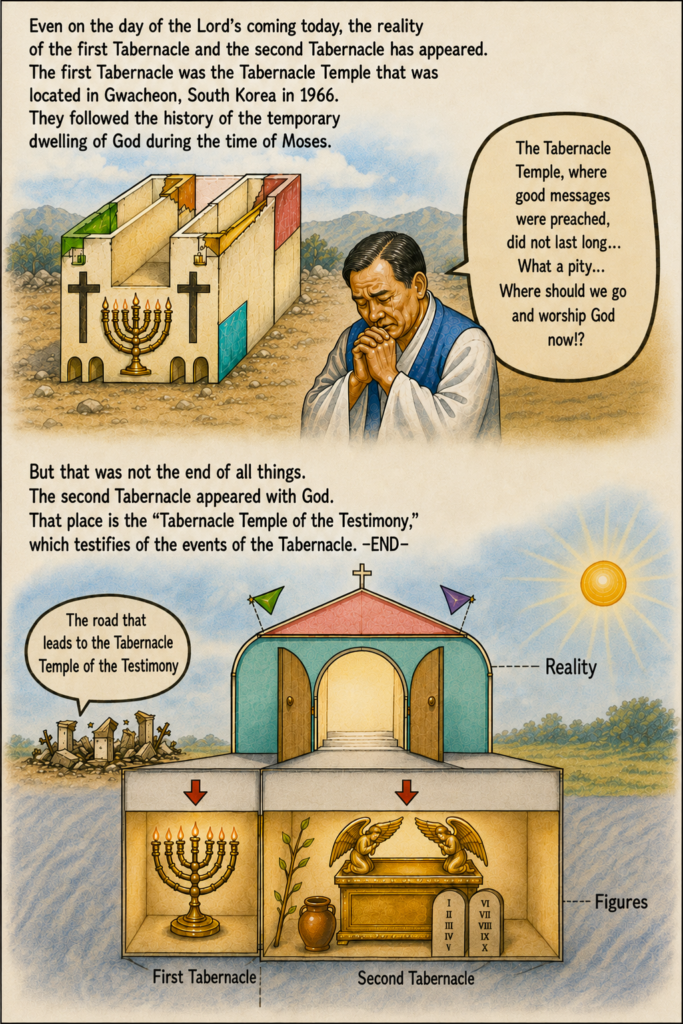
Furthermore, it is understood that these realities will be fulfilled once again at Christ’s Second Coming, just as they were during His first coming.
This does not mean that John the Baptist and Jesus Himself will literally appear again. Rather, different individuals are expected to appear who fulfill the corresponding roles in the events of the Second Coming.
“The mystery of the seven stars that you saw in My right hand and of the seven golden lampstands is this: The seven stars are the angels of the seven churches, and the seven lampstands are the seven churches.”
— Revelation 1:20
This passage is taken from the Book of Revelation, which concerns the events associated with the Second Coming of Christ.
Here again, seven golden lampstands appear.
According to this interpretation, just as John the Baptist served as the lamp before Christ’s first coming, seven messengers will appear before Christ’s second coming to fulfill the role symbolized by the golden lampstands.
It is because the present age is understood to be that time that this explanation is being shared with you.
The remaining time is believed to be short.
Therefore, learn the Scriptures, recognize the reality of the First Tabernacle in our own time, and then seek the Second Tabernacle, where God and Jesus are present together, so that you may attain the hope of the Kingdom of Heaven.