
Here is the English translation of the text provided:
“We have received this, and now we proclaim it to you: according to the Scriptures, Christ died for our sins, was buried, and was raised on the third day according to the Scriptures.” – 1 Corinthians 15:3-4
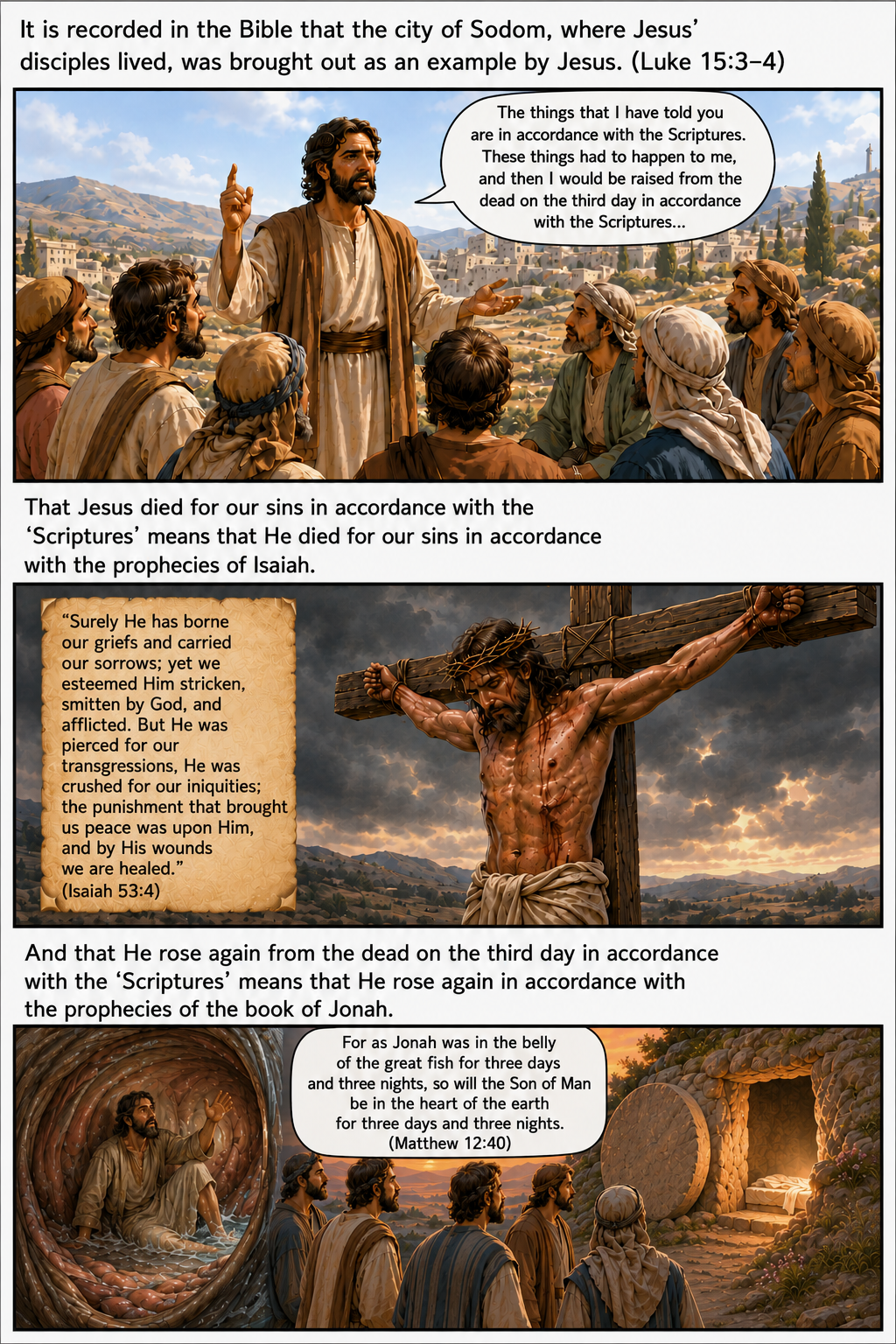
This passage is a portion of a letter written by the Apostle Paul, a disciple of Jesus, to the church in Corinth during that era. In short, it states that Jesus died for our sins “according to the Scriptures” and rose again on the third day “according to the Scriptures.” Here, the phrase “according to the Scriptures” means “according to the prophecies of the Old Testament.” This is because, at that time, the “New Testament” did not exist; only the “Old Testament” did. Therefore, first, there must have been a prophecy in the Old Testament that Jesus would die for our sins, and second, a prophecy that He would rise again on the third day. Today, I would like to speak about this, hoping that you will read it carefully and that it may serve as an occasion for you to gain faith in the Bible.
The following scripture is an Old Testament prophecy that Jesus would die for our sins:
“Surely he took up our pain and bore our suffering, yet we considered him punished by God, stricken by him, and afflicted. But he was pierced for our transgressions, he was crushed for our iniquities; the punishment that brought us peace was on him, and by his wounds we are healed. We all, like sheep, have gone astray, each of us has turned to our own way; and the Lord has laid on him the iniquity of us all. He was oppressed and afflicted, yet he did not open his mouth; he was led like a lamb to the slaughter, and as a sheep before its shearers is silent, so he did not open his mouth. By oppression and judgment he was taken away. Yet who of his generation protested? For he was cut off from the land of the living; for the transgression of my people he was punished.” – Isaiah 53:4-8
The above passage is a prophecy (foretelling) about Jesus recorded by the Old Testament prophet Isaiah. In this passage, “He” and “the “lamb” refer to “Jesus.” At the time of His first coming, John the Baptist testified of Jesus, saying, “Look, the Lamb of God, who takes away the sin of the world!” (John 1:29). In short, the phrase in our main text, “died for our sins according to the Scriptures,” means “died for our sins according to the prophecy of Isaiah.”
Next is the Old Testament prophecy that He would rise again on the third day:
“He answered, ‘A wicked and adulterous generation asks for a sign! But none will be given it except the sign of the prophet Jonah. For as Jonah was three days and three nights in the belly of a huge fish, so the Son of Man will be three days and three nights in the heart of the earth.'” – Matthew 12:39-40
The above passage is Jesus’ response to the scribes and Pharisees (the religious leaders of the Jews at the time) who were asking for a sign (a sign that Jesus was the Savior). In short, He answered that no sign would be given to them except the sign of Jonah. In the past, God chose the prophet Jonah and sent him to the people of Nineveh to lead them to repentance, but Jonah refused and boarded a ship, which was shipwrecked, leaving him trapped in the belly of a fish for three days.
Three days later, the fish spewed Jonah onto dry land, granting him life once more, and he headed toward Nineveh. In the same way, Jesus was crucified, died, and rose again on the third day, appearing to His disciples. That is, the phrase in the main text, “rose again on the third day according to the Scriptures,” means “rose again on the third day according to the prophecy of Jonah.”
In other words, the phrase “according to the Scriptures” recorded in the Bible means “according to the prophecies of the Scriptures.”
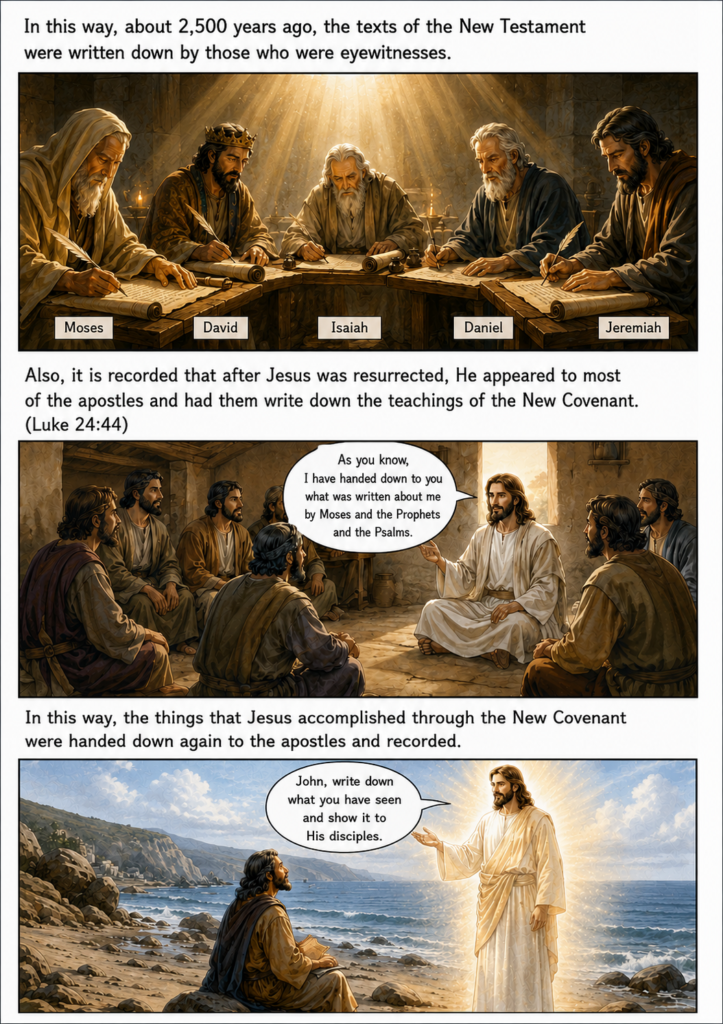
Why am I telling you this story? Because God is the One who makes a prophecy (promise) and fulfills that prophecy (promise). The Bible is largely divided into the “Old Testament” and the “New Testament.” Just as the Chinese characters signify, the Old Testament means “old promise” and the New Testament means “new promise.” Most of the prophecies of the Old Testament were “written concerning Jesus” (Luke 24:44)—meaning that when the Savior (Messiah) came, people should receive Him. At that time, the Old Testament Scriptures belonged to the Jews (physical Israel), and the ones who were supposed to keep the Old Testament were naturally the Jews. However, they did not receive Jesus, who came according to the Scriptures, and failed to keep their promise with God. Instead, they treated Jesus as a heretic and nailed Him to the cross.
The reason God gives prophecies is so that when those prophecies are fulfilled, people may believe that “this is God’s work.”
“I have told you now before it happens, so that when it does happen you will believe.” – John 14:29
The above passage is what Jesus spoke to His disciples at His first coming. In this passage, “what I have told you now before it happens” refers to something spoken before it occurs, which is precisely “prophecy.” Thus, the purpose for which Jesus gave prophecies was also “so that they would believe” when those prophecies were fulfilled.
The Old Testament was a covenant between God and the Jews (physical Israel), but this covenant was not kept. In other words, God fulfilled all the prophecies of the Old Testament through “Jesus” and kept His promise, but the Jews did not believe this fact (John 1:11-12).
“For if there had been nothing wrong with that first covenant, no place would have been sought for another.” – Hebrews 8:7
Because Israel did not receive Jesus, a flaw arose in the covenant, and the prophecies that Jesus fulfilled regarding the Old Testament came to be proclaimed to all nations through Jesus’ disciples (Matthew 24:14). Therefore, the second covenant that was established is the “New Testament” (Luke 22:14-20). While the first covenant (Old Testament) was a covenant between God and Israel, the second covenant (New Testament) is a covenant between Jesus and spiritual Israel (those who have believed in Jesus and begun their faith). In short, the “second one” in the above passage refers to the New Testament. Therefore, simply saying, “I attend church. I am diligent in my faith. I believe in Jesus,” does not mean one will automatically go to heaven. In other words, one can receive salvation only by keeping the promise with Jesus (the New Testament).
I will now speak about “How then shall I keep the promise with Jesus (the New Testament)?” As recorded earlier, the reason God made a prophecy (promise) was so that people would believe when it was fulfilled. That is, at His first coming, because Jesus came according to the Old Testament prophecies, believing in and receiving Jesus was the act of keeping the promise with God. In other words, the people who came to Jesus even while facing misunderstanding and persecution were the ones who kept God’s promise. A prime example would be Jesus’ 12 disciples.
The problem lies at the time of the Lord’s Second Coming. The question is how everyone currently practicing faith within Christianity can keep the promise with Jesus.
About 2,000 years ago, after His resurrection and ascension, Jesus appeared to the disciple John, who was exiled on the island of Patmos, and spoke to him about things to come (prophecies). That is the “Book of Revelation,” recorded by the Apostle John. As you well know, it is the representative prophetic book, which is the final book of the New Testament. However, just like the prophecies of the Old Testament, its meaning was hidden through parables until the appointed time (Revelation 5:1-3).
Jesus stated during His lifetime that this hidden meaning would be clearly made known when the Counselor, the Holy Spirit, comes (John 16:25). Furthermore, it is recorded that this Counselor, the Holy Spirit, dwells within a physical body. In other words, it means that the Holy Spirit does not appear directly to a person in a visible spirit form to teach them.
One of the reasons the Jews at the first coming failed to receive Jesus was precisely because they did not know the Old Testament prophecies. That is, because even the Old Testament’s meaning was hidden through parables, they could not recognize Jesus as the Savior. However, the people who came to Jesus were able to truly believe in Him because Jesus Himself interpreted those parables for them.
Spiritual Israel (Christianity) at the time of the Second Coming is in the exact same position as physical Israel. In the “Book of Revelation,” which records the events of the Second Coming, “the messenger sent by Jesus for the churches” appears (Revelation 22:16). The work that this person does is interpreting the parables of the Book of Revelation and making them known to the people (Revelation 10:11).
This is because one must know the parabolic meanings in order to realize and believe in the physical realities that were prophesied in the Book of Revelation. Believing in this person (Jesus’ messenger) who makes known these parables and their physical fulfillment is the very act of keeping the promise with Jesus. Conversely, rejecting or persecuting this person is failing to keep the promise, just like the Jews of old. In short, the Old Testament was a prophecy concerning “Jesus,” and the New Testament is a prophecy concerning “Jesus’ messenger.” Keeping the promise at the first coming was “receiving Jesus,” and keeping the promise at the second coming means “receiving Jesus’ messenger.”
Summary
The Bible is largely divided into the Old and New Testaments. The Old Testament was a covenant between “God and Israel,” but it was annulled because the Jews did not receive Jesus. The New Testament is a covenant between “Jesus and spiritual Israel.” The promises (Old and New Testaments) spoken of in the Bible refer to prophecies, and the New Testament refers to the representative prophetic book of the New Testament, the “Book of Revelation.” In other words, spiritual Israel (modern Christians) must keep the Book of Revelation, which is the promise with Jesus, in order to go to heaven. To keep the promise (the New Testament: the Book of Revelation), one must naturally know the parabolic meanings recorded in the Book of Revelation and their fulfilled physical realities. To know this, one must meet “the messenger sent by Jesus for the churches” who has seen those fulfilled realities and learn the words of the Bible from him. Only then can one see the fulfillment of the prophecies and believe that this is God’s work.
- The Old Testament (Prophecy of the Old Testament): God prophesied and fulfilled it through the prophets, but physical Israel (the Jews) failed to receive Jesus who came according to the Old Testament prophecy, causing the covenant to be broken.
- The New Testament (Prophecy of the New Testament: The Book of Revelation): Jesus prophesied through the disciple John and recorded the contents to be fulfilled, but its meaning is hidden through parables.
- How to keep the New Testament? One must meet Jesus’ messenger to learn the parabolic meanings in order to know and believe in the physical realities that have appeared according to the Scriptures (prophecies). Believing means keeping the promise with Jesus. Conversely, neither learning nor believing means breaking the promise, just like the Jews of old.