
Jesus’ Life-Giving Words
“Jesus said to them, ‘Truly, truly, I say to you, unless you eat the flesh of the Son of Man and drink His blood, you have no life in yourselves. Whoever eats My flesh and drinks My blood has eternal life, and I will raise him up at the last day. For My flesh is true food, and My blood is true drink.'” — John 6:53–55
The passage above records words that Jesus spoke to the Jews during His First Coming (when He first came to the earth). Jesus told them that unless they ate His flesh and drank His blood, they had no life. When He said this, many of the Jews misunderstood His words literally, thinking He was referring to physical flesh and blood, and they became disturbed (John 6:52). However, the “flesh and blood” that Jesus spoke of was figurative. He was not speaking about physical flesh and blood. Let us examine through the Bible what Jesus meant by His “flesh and blood” during His First Coming.
In the Old Testament era, when the people of Israel were living as slaves in Egypt (modern-day Egypt), God chose Moses and sent him to Israel in order to fulfill the promise He had made to Abraham (Genesis 15:13–16).
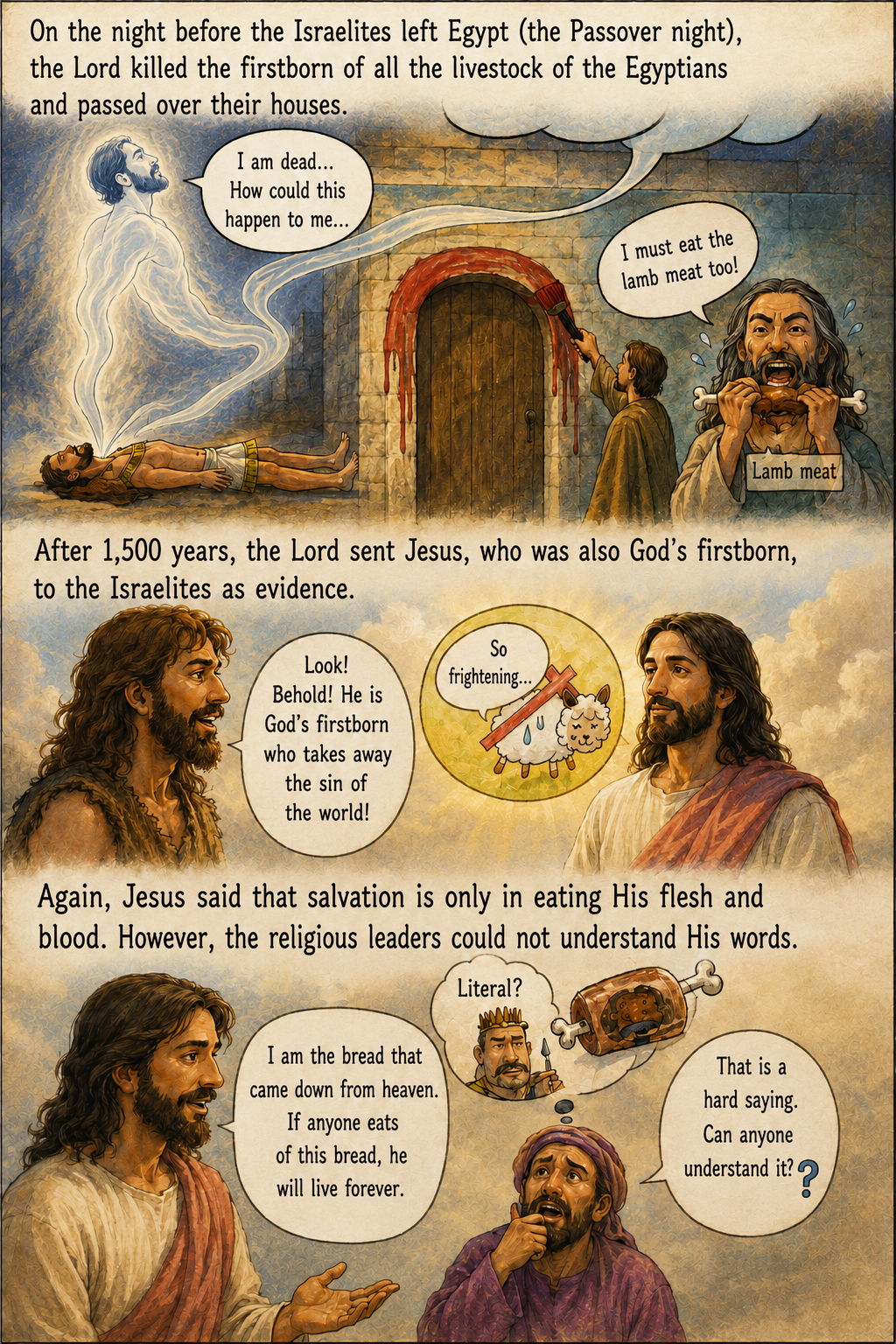
However, Pharaoh, the king of Egypt, refused Moses’ request to let the Israelites go. As a result, ten plagues came upon Egypt. The final plague was the death of every firstborn, both man and beast. Through Moses, God revealed to the Israelites how they could escape this judgment: they were to apply the blood of a lamb to the doorposts of their houses and eat the flesh of the lamb.
On the night of the Passover (the feast commemorating how the plague “passed over” Israel), the firstborn throughout Egypt died by the hand of God’s angels. But when the angels saw the blood of the lamb on the Israelites’ doorposts, they did not enter those houses. In this way, the Israelites were spared from the plague. They were saved through the blood and flesh of the lamb. After this final plague, Pharaoh finally released the people of Israel.
During His First Coming, John the Baptist—the one who came to prepare the way for Jesus—testified concerning Him:
“Behold, the Lamb of God, who takes away the sin of the world!”
In other words, John identified Jesus as the Lamb.
Jesus also declared that people must eat His flesh and drink His blood in order to have life. Just as the Israelites received salvation by the blood and flesh of the Passover lamb in the Old Testament, those living at the time of Jesus’ First Coming could receive salvation by partaking of the blood and flesh of Jesus, the true Lamb. Unlike the Old Testament, however, Jesus was speaking not of literal flesh and blood but of spiritual flesh and blood.
During His First Coming, Jesus proclaimed to the people of Israel the true meaning of the Old Testament Scriptures, whose message had been written in parables, after receiving it from God (Ezekiel chapters 1–3).
Most of the Jews, however, did not accept His testimony (John 3:32), largely because they lacked a proper understanding of the Old Testament prophecies. Since Jesus’ teaching differed from what they had received from the scribes and Pharisees—the religious leaders of Judaism at that time—they condemned Him as a heretic and crucified Him.
“And this is eternal life, that they may know You, the only true God, and Jesus Christ whom You have sent.” — John 17:3
As this passage states, Jesus taught that eternal life comes through knowing the one true God and Jesus Christ whom He sent. How, then, can a person truly know God and Jesus?
According to the Bible, the answer is revelation.
“All things have been handed over to Me by My Father. No one knows the Son except the Father, and no one knows the Father except the Son and anyone to whom the Son chooses to reveal Him.” — Matthew 11:27
As Jesus testified, without revelation one cannot truly know God or the Son. Therefore, if eternal life comes through knowing God and Jesus, and such knowledge comes through revelation, then revelation is essential for receiving life.
Here, “revelation” does not refer to seeing dreams or visions. Rather, as explained previously, it refers to the fulfillment of the figurative meanings hidden within the Old Testament Scriptures—the revealed reality that appears when those meanings are opened and interpreted.
From the time of Moses, the Old Testament was written over a period of approximately 2,500 years. At Jesus’ First Coming, its hidden meaning was revealed. Those who believed that revelation received salvation through Christ.
Afterward, Jesus bore the cross to atone for the sins of the world. Three days after His death, He rose again and appeared to His disciple, the Apostle John, giving him the visions recorded in the Book of Revelation. Since then, the meaning of Revelation has remained hidden for nearly 2,000 years.
Throughout that time, many false shepherds interpreted Revelation according to their own understanding. As their doctrines differed, Christianity experienced numerous divisions.
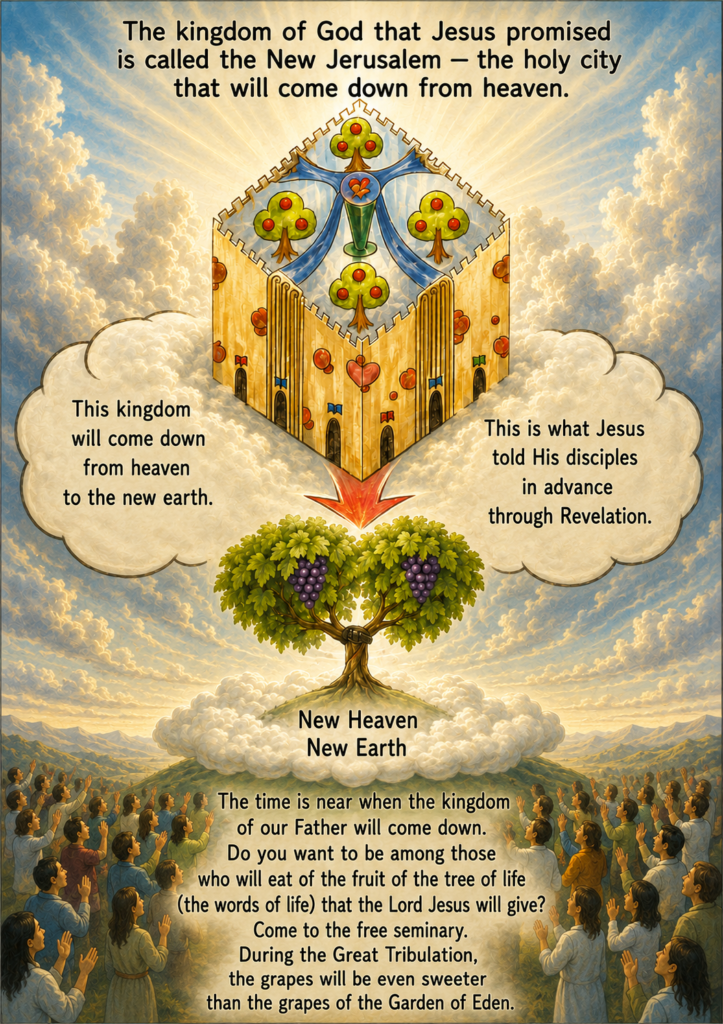
The appearance of the fulfilled reality of Revelation signifies that the time of Jesus’ Second Coming is drawing near. The Book of Revelation prophesies that Jesus Himself will break the seven seals of the sealed scroll and give the opened scroll to one person to eat (Revelation chapters 5, 6, 8, and 10). Just as Jesus received and proclaimed God’s revealed word during His First Coming, the prophecy indicates that at His Second Coming there will likewise appear one person who receives the revealed book from Jesus and His angel.
Simply put, according to this interpretation, one must meet the person who receives revelation from Jesus at the Second Coming in order to receive the revelation of the New Testament. By receiving this New Testament revelation, one comes to know the true God and Jesus Christ, and through that knowledge receives salvation, just as Jesus taught.
“They overcame him by the blood of the Lamb and by the word of their testimony; they did not love their lives even unto death.” — Revelation 12:11
Accordingly, this interpretation concludes that at the Second Coming as well, salvation is received through the blood and flesh of Jesus—that is, through the revealed message of the New Testament.