

Revelation and the Actual Realities of the New Testament Fulfillment
“And now I have told you before it comes to pass, that when it comes to pass, you may believe.” — John 14:29
The verse above is what Jesus spoke to His disciples before He went to the cross—it can be considered His final testament. In this passage, “what I have told you before it comes to pass” refers to the “prophecies” spoken by Jesus. In the Bible, prophecy signifies a “promise.” The Old Testament prophesied (promised) through its prophets that the Savior, Jesus, would come to this earth, while the New Testament prophesies (promised) through the Apostle John (one of Jesus’ twelve disciples) that Jesus will return to this earth.
The prophecies of the Old Testament were completely fulfilled through Jesus (John 19:30), whereas the prophecies of the New Testament still awaited fulfillment. The Old Testament prophesied that a Savior would be sent for Israel, but because the Jews (physical Israel) at the First Coming did not receive Jesus, that promise was broken (John 1:11).
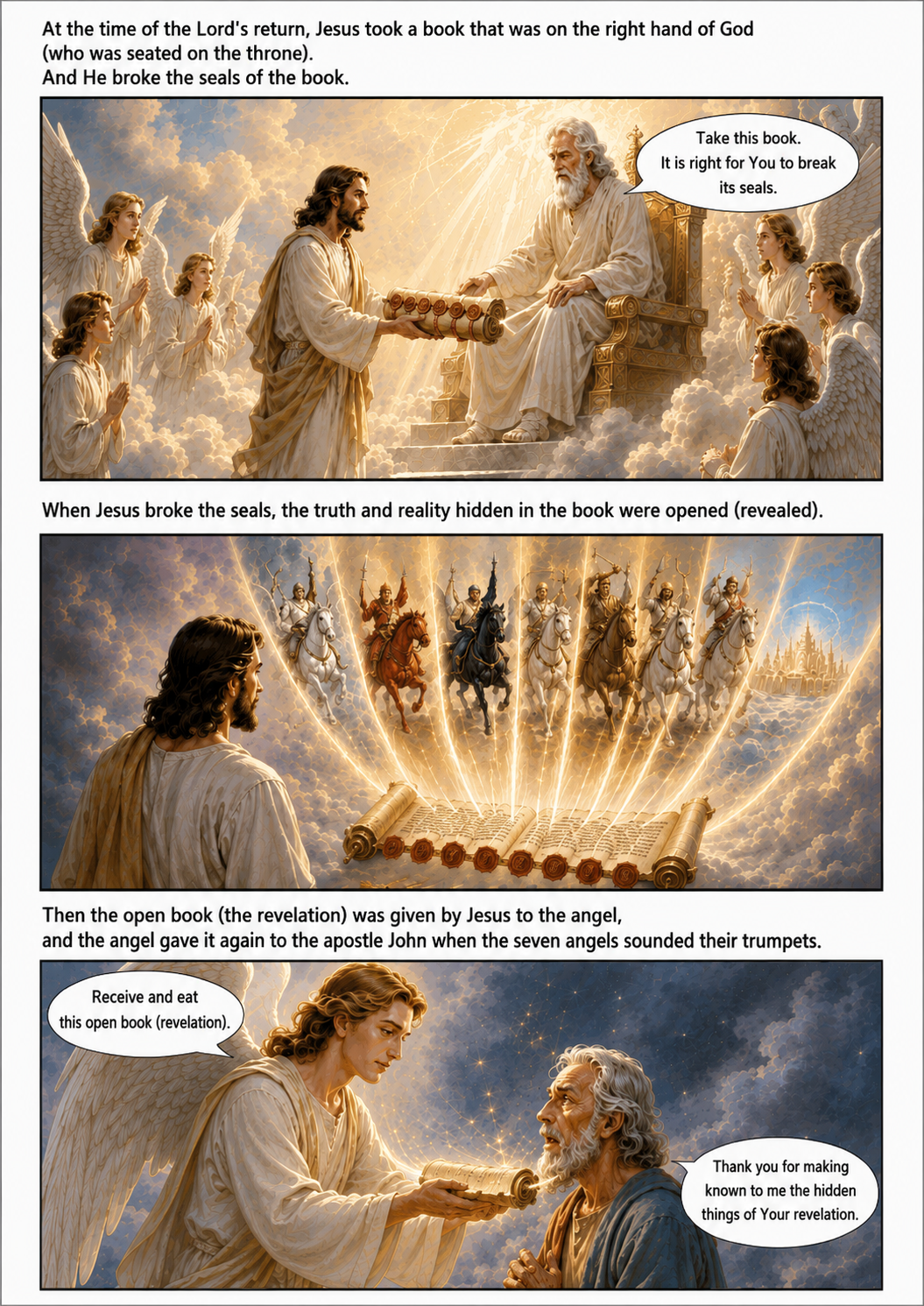
About 2,000 years ago, after Jesus was crucified and resurrected, He appeared to the disciple John—who was exiled on the island of Patmos—and revealed the things that would take place in the future. This is the “Book of Revelation,” which John received through a vision and recorded. The prophecy spoken by Jesus in the text refers precisely to this “prophecy of the Book of Revelation.”
Therefore, one must understand the meaning of the New Testament—the Book of Revelation—to believe it, and only by believing can one attain salvation. However, much of the Book of Revelation is recorded in parables, making its contents difficult to grasp easily. Because various pastors interpret it according to their own personal opinions and thoughts, many Christians may feel confused about which message (interpretation) to believe.
To give you the answer first: in order to discern whether an interpretation is true or false, there must definitely be the “actual realities (실상, Silsang)” that have been fulfilled and manifested in accordance with that interpretation. A doctrine without actual realities is a false testimony—much like the “fruit of the knowledge of good and evil (false doctrines)” that Adam ate. Furthermore, we must have not just partial interpretations and realities, but an interpretation and actual realities concerning the entirety of the Book of Revelation. Let us look at an example to help you understand.
“It also forced all people, great and small, rich and poor, free and slave, to receive a mark on their right hands or on their foreheads, so that they could not buy or sell unless they had the mark, which is the name of the beast or the number of its name. This calls for wisdom. Let the person who has insight calculate the number of the beast, for it is the number of a man. That number is 666.” — Revelation 13:16–18
I once saw a pastor on a broadcast interpret the “Mark of the Beast (666)” from the verse above as a “barcode,” and explained that the beast administering this “666” mark is a “machine.” Thus, he presented an interpretation of the prophecy and its realities based on his own thoughts. However, the verse states that “the number of the beast = the number of a man,” meaning “beast = man.” With such partial and misapplied realities, it is difficult to discern whether a person’s interpretation is true or false.
The Bible compares human beings to “beasts” (Proverbs 30:2–3). Therefore, the “beast” recorded in Revelation refers to “people.” Interpreting the beast as a “machine” means it is a “false testimony.” No matter how famous and popular a pastor who gives false testimonies may be, he is a “false pastor.” As such, we must not judge biblical prophecies based solely on partial interpretations and realities; rather, a comprehensive interpretation of the entire Book of Revelation and actual realities corresponding to that interpretation must firmly back it up.
Why We Must Receive Testimony of the New Testament Fulfillment
The most important reason we must receive testimony regarding the fulfillment of the New Testament (the Book of Revelation) is because the Bible records that anyone who adds to or subtracts from the Book of Revelation cannot enter the kingdom of heaven and will instead receive plagues (Revelation 22:18–19).
Simply put, you must receive testimony of the actual entities that have appeared through the fulfillment of the New Testament so that you can believe, “Ah, the biblical prophecies were fulfilled just like this!” Only by believing can you keep your promise with Jesus and receive salvation. God has firmly established that adding to or subtracting from Revelation keeps you out of heaven. If someone goes ahead and adds to or subtracts from it, yet thinks, “I still believed in Jesus and lived a life of faith, so I will go to heaven,” that is merely self-delusion. They cannot be recognized by God.
- “Adding to” the Book of Revelation means interpreting Revelation according to one’s own thoughts.
- “Subtracting from” it means ignoring the words of Revelation and failing to keep them.
Ultimately, this means that most Christian believers have “added to and subtracted from” the Book of Revelation. To master the Book of Revelation, you must come to Shincheonji to learn the words of the Bible anew. May you keep your promise with Jesus and attain your hope. Thank you.