The Signs of the End Times: War, Famine, and Earthquakes
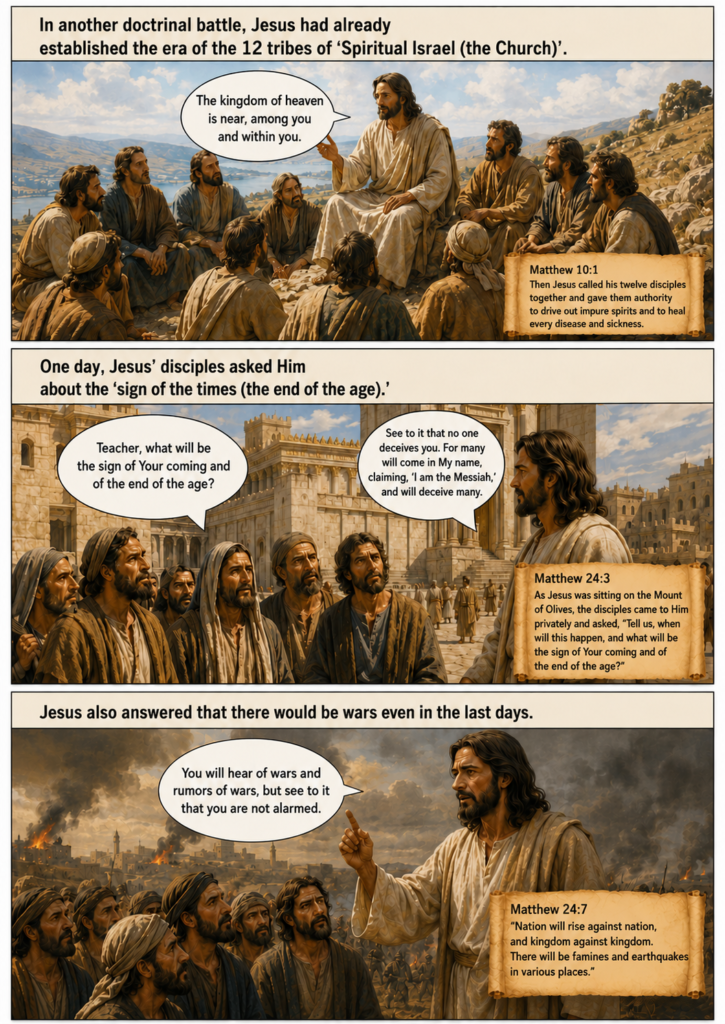
“As Jesus was sitting on the Mount of Olives, the disciples came to Him privately and asked, ‘Tell us, when will these things happen, and what will be the sign of Your coming and of the end of the age?’
Jesus answered, ‘See to it that no one deceives you. For many will come in My name, claiming, “I am the Christ,” and will deceive many. You will hear of wars and rumors of wars, but see to it that you are not alarmed. Such things must happen, but the end is still to come. Nation will rise against nation, and kingdom against kingdom. There will be famines and earthquakes in various places. All these are the beginning of birth pains.'”
— Matthew 24:3–8
The passage above records a conversation between Jesus and His disciples approximately 2,000 years ago. The disciples asked Jesus about the signs of the end of the world, that is, the last days. Jesus’ first answer was, “Be careful that no one deceives you.” Since deception was explained in the previous article, today I would like to focus on the remainder of Jesus’ answer.
Jesus foretold that, in addition to deception, there would be wars between nations, famines, and earthquakes before the end.
Since Jesus departed from the earth, countless wars have taken place throughout human history. Many nations have suffered famine, and earthquakes have occurred repeatedly. If these signs have continued for centuries, why has the world not yet come to an end?
The answer is that the wars, famines, and earthquakes Jesus spoke of are not merely physical events but spiritual ones.
The word spiritual means that these prophecies contain a deeper, symbolic meaning. Therefore, to understand Jesus’ words correctly, we must understand their inner significance.
“A man is not a Jew if he is only one outwardly, nor is circumcision merely outward and physical. No, a man is a Jew if he is one inwardly; and circumcision is circumcision of the heart, by the Spirit, not by the written code.”
— Romans 2:28–29
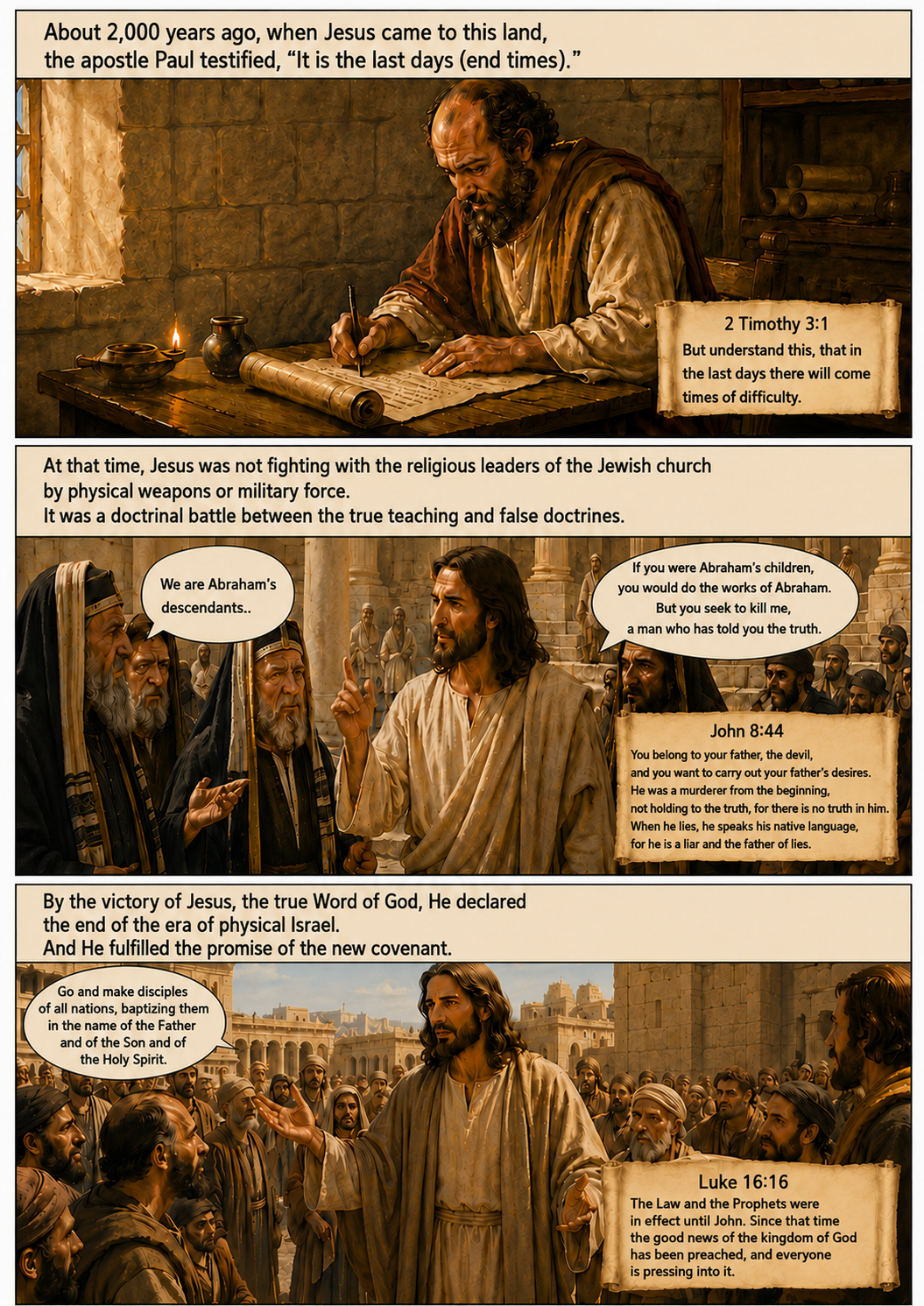
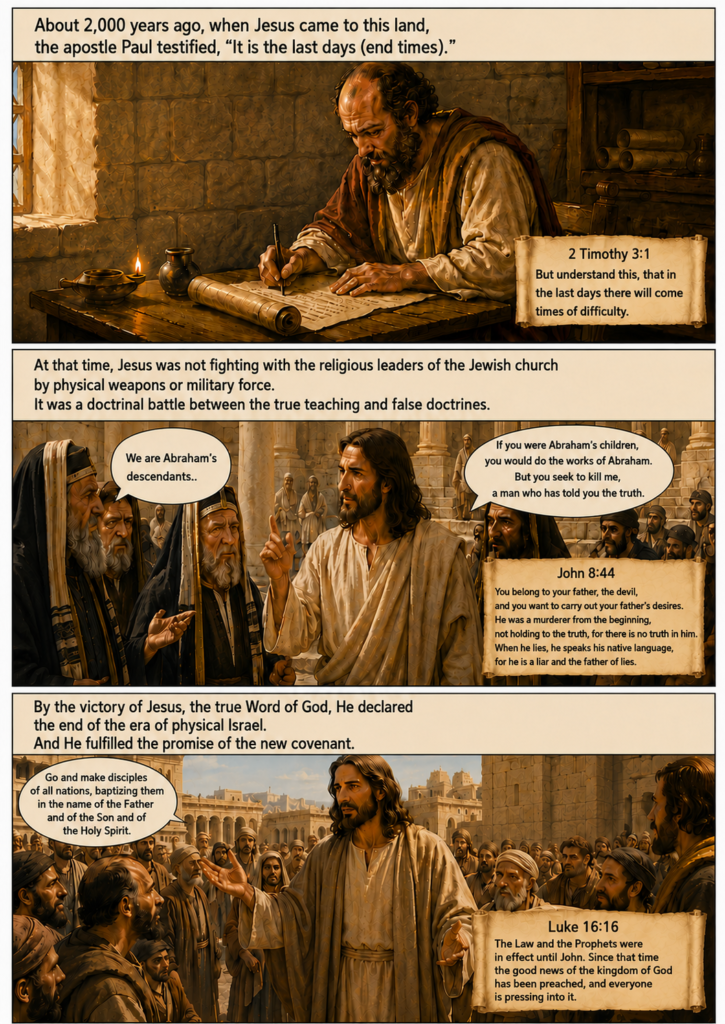
The “outward Jew” refers to one who understands Scripture only literally, whereas the “inward Jew” refers to one who understands its hidden meaning. At Jesus’ first coming, His disciples were the inward Jews, while the religious leaders of Judaism and their followers were the outward Jews.
In other words, the true believer is the one who understands God’s intended meaning. Therefore, to become an “inward Jew,” one must understand the figurative language and hidden meaning within Scripture.
Let us now return to the subject of the signs of the last days.
1️⃣ War
From the beginning of history, there have been conflicts between God’s chosen people and those outside His covenant.
In the beginning, there was the conflict between Adam and the serpent. Adam failed to keep God’s covenant and was overcome by the serpent (the shepherd used by Satan).
During the period of the Judges, God’s chosen leaders (such as Samson) fought against Gentile nations like the Philistines.
During the period of the Kings, Jerusalem fought against Babylon. Solomon, the king of physical Israel, worshiped foreign gods, broke God’s covenant, and Jerusalem was eventually conquered by Babylon.
One important lesson appears consistently throughout Scripture:
Victory or defeat is not determined by human strength, authority, or wisdom, but by whether God’s covenant is kept.
Those who keep the covenant overcome; those who break it are defeated (Deuteronomy 28).
At Jesus’ first coming, the nature of this conflict changed. The battle became one between spiritual Israel and spiritual Gentiles.
Jesus declared:
“Take heart! I have overcome the world.”
— John 16:33
The “world” here does not refer to the entire planet but to the religious leaders of Judaism—the scribes and Pharisees—who opposed Him.
The pattern of these conflicts throughout biblical history may be summarized as follows:
| Era | God’s Kingdom (Chosen People) | Satan’s Kingdom |
|---|---|---|
| Beginning | Adam | The Serpent |
| Period of the Judges | Physical Israel | Philistines |
| Period of the Kings | Jerusalem | Babylon |
| First Coming of Jesus | Spiritual Israel | Religious leaders of Judaism |
| Second Coming of Jesus | Spiritual New Israel | Spiritual Babylon |
Thus, when Jesus said that “nation will rise against nation, and kingdom against kingdom,” this interpretation understands it as referring to a conflict between God’s kingdom (Jerusalem) and Satan’s kingdom (Babylon), rather than a conventional military war.
Accordingly, interpreting this prophecy as referring to events such as a Middle East war or a third world war is regarded, within this interpretation, as incorrect.
In the Old Testament, because the era was physical, the weapons used were physical weapons.
However, with the coming of Jesus, a spiritual era began, and the weapons also became spiritual.
“Take… the helmet of salvation and the sword of the Spirit, which is the word of God.”
— Ephesians 6:17
The weapon of God’s people is His Word.
By contrast, the devil’s weapon is falsehood (John 8:44).
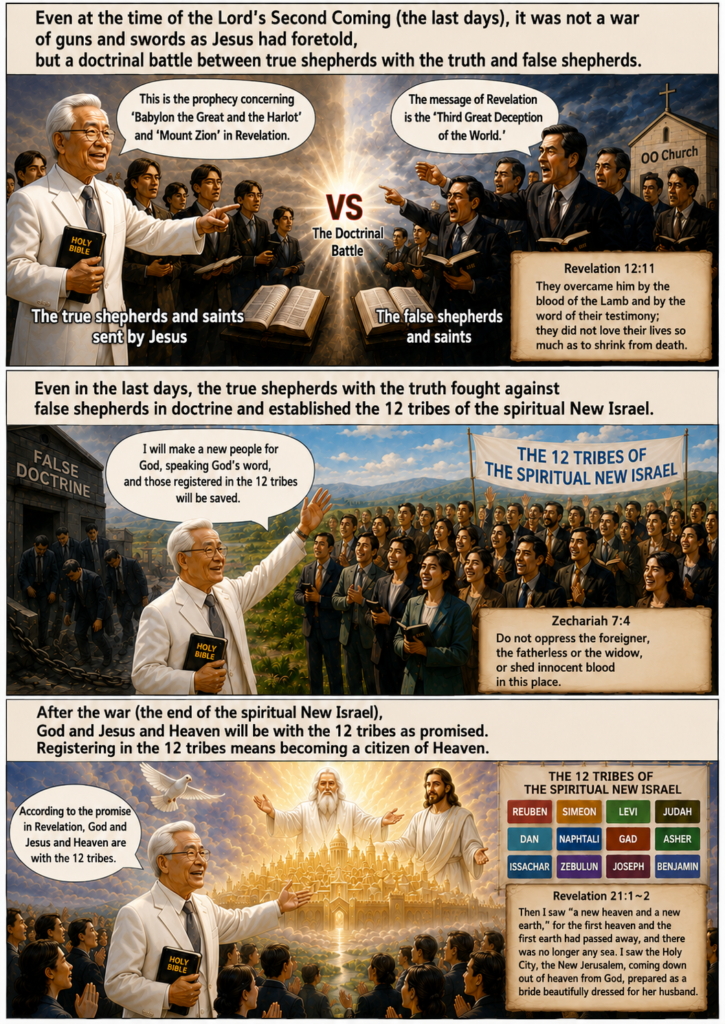
Therefore, this interpretation understands the war at Christ’s Second Coming as a spiritual battle, fought with God’s Word rather than physical weapons.
Those who do not understand God’s Word cannot keep His covenant and may be deceived, just as Adam was deceived.
This is why Jesus first warned,
“See to it that no one deceives you.”
The conflict between kingdoms is therefore understood as a conflict between God’s people and those belonging to Satan, fought through opposing teachings and doctrines.
“They overcame him by the blood of the Lamb and by the word of their testimony.”
— Revelation 12:11
“The dragon… went off to wage war against the rest of her offspring—those who keep God’s commandments and hold fast their testimony about Jesus.”
— Revelation 12:17
2️⃣ Famine
A famine normally refers to a shortage of food.
However, Jesus identified Himself as the bread from heaven (John 6).
In Scripture, food symbolizes God’s Word. Just as physical food sustains the body, God’s Word sustains the spirit.
According to this interpretation, the famine in the last days is not primarily a shortage of physical food but a shortage of the true Word of God.
When religious leaders teach human ideas instead of God’s truth, people are left spiritually hungry.
At that time, it is understood that the promised messenger of Jesus will bring the true Word, restoring spiritual life to those who receive it.
“The days are coming… when I will send a famine through the land—not a famine of food or a thirst for water, but of hearing the words of the Lord.”
— Amos 8:11
“To the one who is victorious, I will give some of the hidden manna.”
— Revelation 2:17
Thus, the famine Jesus foretold is understood here as a time when genuine biblical truth becomes difficult to find because false teachings have become widespread.
The author further argues that contemporary moral failures among clergy illustrate this spiritual condition and suggests that such leaders cannot faithfully teach God’s Word.
3️⃣ Earthquake
A physical earthquake causes the earth to shake.
What, then, is a spiritual earthquake?
Jesus once described John the Baptist as “a reed shaken by the wind.”
John initially testified that Jesus was the Savior, but later began to question Him, showing uncertainty.
According to this interpretation, the “shaking” represented instability of heart and faith.
Likewise, the earthquakes of prophecy symbolize people’s hearts being shaken.
“The powers of the heavens will be shaken.”
— Matthew 24:29
In biblical symbolism, the heavens often represent God’s people (Genesis 37:9–11).
Therefore, the shaking of heaven is understood as God’s people experiencing spiritual confusion and instability.
Conclusion
In summary, this interpretation understands the signs of the last days in the following way:
- War refers to a spiritual conflict between God’s kingdom (Jerusalem, the Tree of Life) and Satan’s kingdom (Babylon, the Tree of the Knowledge of Good and Evil). The weapons are truth and falsehood, that is, competing doctrines.
- Famine refers to a lack of God’s true Word. During this time, God’s chosen messenger brings the hidden manna (true teaching), while Satan’s servants distribute the wine of spiritual adultery (false teaching).
- Earthquakes symbolize God’s people experiencing spiritual instability and confusion.
According to this interpretation, if these conditions are present, then the age has already entered the period described as the “last days.”
The author therefore concludes that ministers who interpret Jesus’ prophecies about war, famine, and earthquakes only in a literal, physical sense are teaching error rather than truth.
Readers are encouraged to discern for themselves what is true and false, to understand God’s Word correctly, and thereby obtain eternal life.
Thank you.
“The beast opened its mouth to blaspheme God, and to slander His name and His dwelling place and those who live in heaven. It was given power to wage war against God’s holy people and to conquer them…”
— Revelation 13:6–7
(Interpreted here as describing the conflict between God’s kingdom and Satan’s kingdom during the fulfillment of Revelation.)
“I looked, and there before me was a pale horse! Its rider was named Death… They were given power over a fourth of the earth to kill by sword, famine, plague, and by the wild beasts of the earth.”
— Revelation 6:8
(Interpreted here as referring to the famine of the last days during the fulfillment of Revelation.)
“I watched as He opened the sixth seal. There was a great earthquake. The sun turned black… the whole moon turned blood red, and the stars in the sky fell to earth…”
— Revelation 6:12–13
(Interpreted here as referring to the earthquake of the last days during the fulfillment of Revelation.)