The Promised Shepherd, the Overcomer, and the Twelve Tribes
“I have told you these things, so that in me you may have peace. In this world you will have trouble. But take heart! I have overcome the world.” — John 16:33
Many believers place their faith in Jesus, acknowledging Him as the Promised Shepherd or the Savior (Messiah). However, if someone were to ask, “Why is Jesus the Promised Shepherd?”, few believers could give a clear answer. Let us examine through the Scriptures why Jesus is indeed the Promised Shepherd.
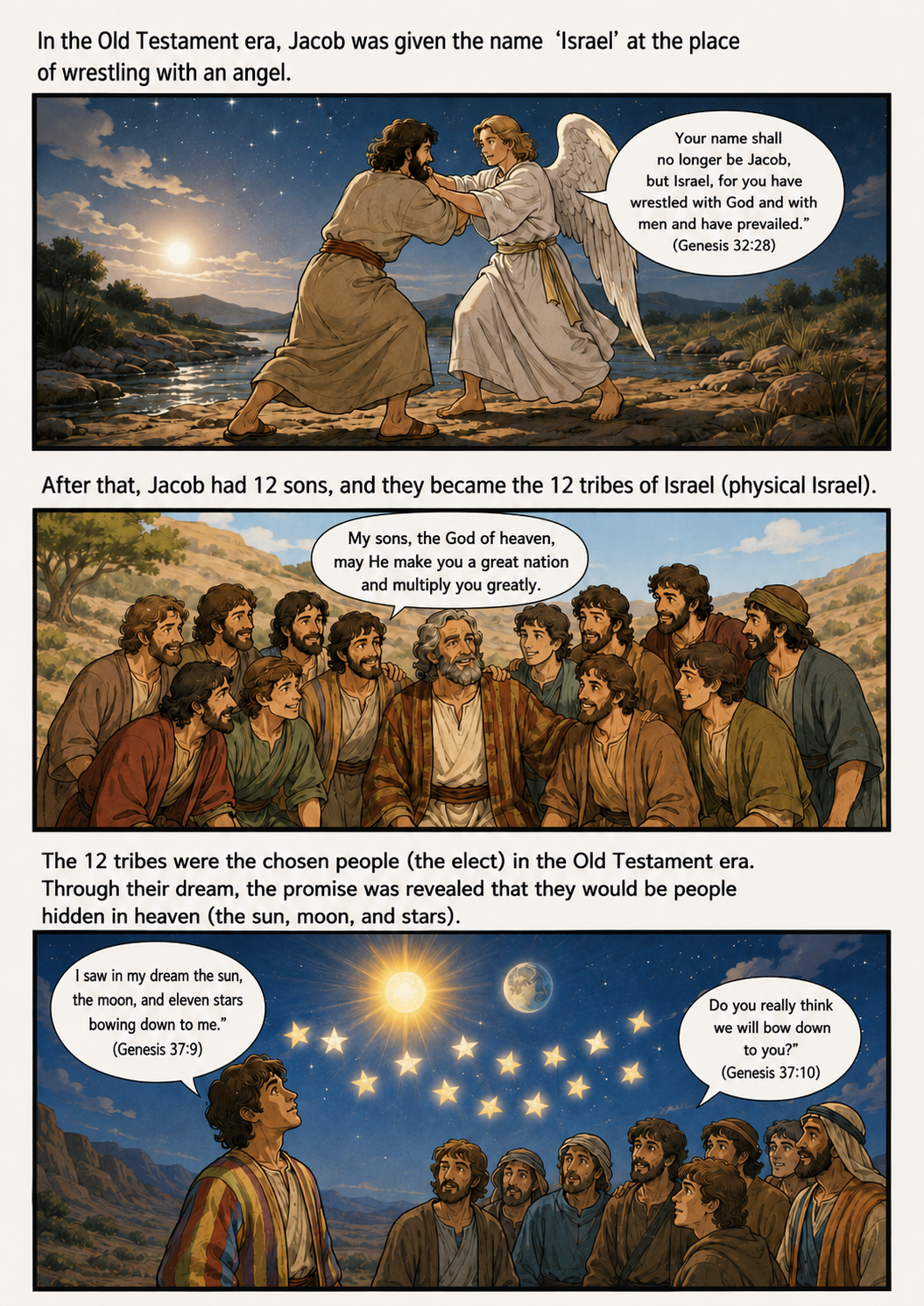
During the Old Testament era, Jacob wrestled with an angel at the ford of the Jabbok and prevailed (Genesis 32:24–28). Because of this event, Jacob’s name was changed to “Israel,” which means “one who has overcome.” Later, Jacob fathered twelve sons, who became the ancestors of the (physical) twelve tribes of Israel.
By the time of Moses, God fulfilled His covenant with Abraham by causing them to multiply greatly in Egypt, after which these twelve tribes entered the promised land of Canaan. However, during the time of Solomon, they broke their covenant with God and served foreign gods, leading to the complete destruction of the twelve tribes of Israel by foreign nations. The reason they lost the war against foreign nations was that they broke God’s covenant (the Ten Commandments of that time). Had they kept the covenant, they would not have suffered defeat by foreign nations (Deuteronomy 28).
To Israel, which had thus been destroyed, God sent Old Testament prophets to deliver a final covenant, giving them one last chance. In short, that covenant was that God would send His Son for the people of Israel, and that they must believe in Him.
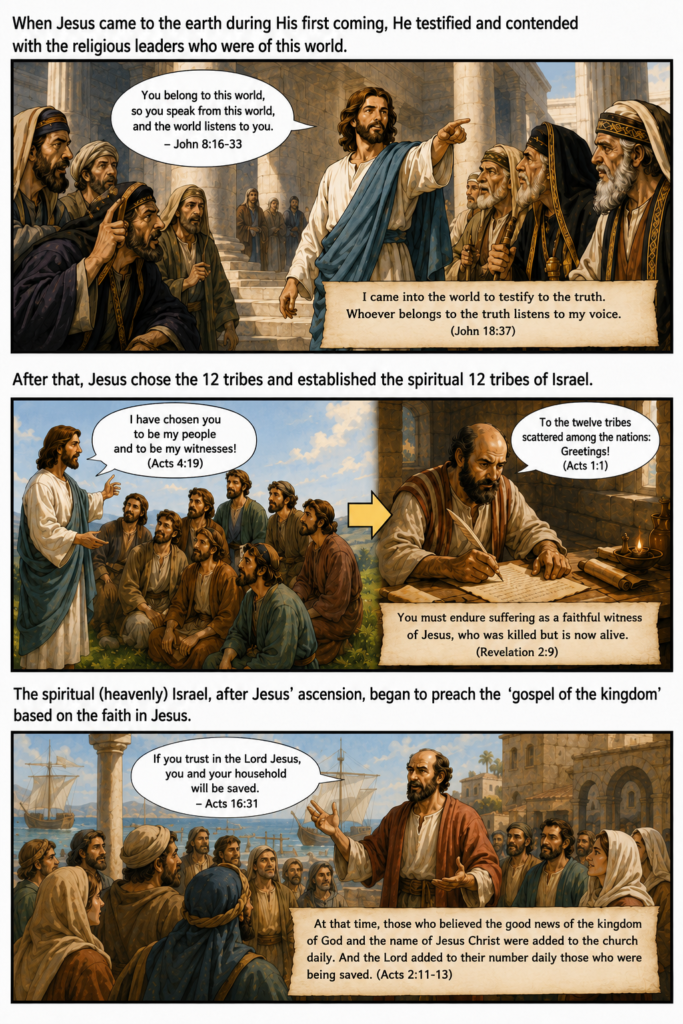
However, most of the Israelites (the Jews at the First Coming) did not keep God’s covenant—meaning they did not believe the words of the Old Testament. Consequently, they were unable to receive Jesus, who appeared according to the prophecies of the Old Testament. Because of this, the gospel of Jesus was proclaimed to all Gentile nations through His disciples (Matthew 24:14).
People who accepted that gospel formed a new Israel, namely “Spiritual Israel.” Put simply, today’s Christians are “Spiritual Israel.” Just as physical the twelve tribes of Israel were created because Jacob overcame in his wrestling match with the angel, the twelve tribes of Spiritual Israel were created because Jesus overcame the shepherd used by the devil at the First Coming (John 16:33).
In short, the Promised Shepherd spoken of in the Bible is the Overcomer, and the proof of having overcome is that he must establish the twelve tribes—just as Jacob and Jesus did. In the Old Testament, Jacob overcame an angel; at the First Coming, Jesus overcame the pastors of the devil with the truth. While conflict existed in both eras, the weapon required to gain victory differed between the Old Testament and the First Coming.
The Promised Shepherd and the Twelve Tribes at the Second Coming
Let us now discuss the Promised Shepherd and the twelve tribes at the time of the Lord’s Second Coming. To achieve victory, there must first be an “opponent to fight.”
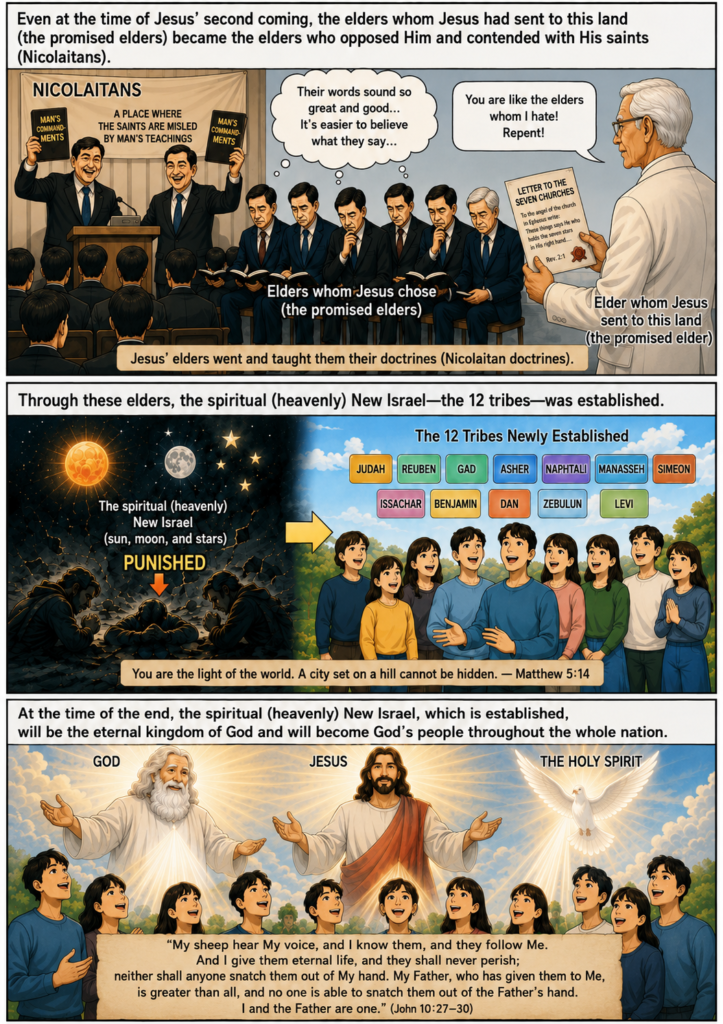
“Nevertheless, I have a few things against you: There are some among you who hold to the teaching of Balaam, who taught Balak to entice the Israelites to sin so that they ate food sacrificed to idols and committed sexual immorality. Likewise, you also have those who hold to the teaching of the Nicolaitans. Repent therefore! Otherwise, I will soon come to you and will fight against them with the sword of my mouth. Whoever has ears, let them hear what the Spirit says to the churches. To the one who is victorious, I will give some of the hidden manna. I will also give that person a white stone with a new name written on it, known only to the name’s recipient.” — Revelation 2:14–17
The Book of Revelation is a prophecy recorded by the Apostle John, a disciple of Jesus, detailing events at the time of the Lord’s Second Coming. The passage above introduces four entities: “Balaam,” “Balak,” “the Nicolaitans,” and “the one who is victorious (the Overcomer).”
As recorded that God spoke in parables through the prophets, when prophecies are fulfilled, the literal realities corresponding to these figures appear (Hosea 12:10). This means that the historical Balaam, Balak, and Nicolaitans do not literally come back to life.
To explain briefly: Balaam was an Old Testament prophet who believed in God, but accepted wealth from Balak, the king of Moab (a foreign nation at the time), and gave counsel that led God’s chosen people of Israel to destruction. Nicolaus was a person who converted from Judaism to the church of Jesus during the First Coming, but later formed a faction and broke away from the church. In other words, Balaam, Balak, and the Nicolaitans appearing in the passage are symbolic figures representing those who destroyed God’s people. They are the opponents who must be fought at the Second Coming, and the one who fights and overcomes them is the proof of being the shepherd promised by Jesus. Furthermore, the twelve tribes established through the Overcomer are the “New Spiritual Israel” created at the Second Coming (Revelation 7).
During the Old Testament era, when the physical nation of Israel broke God’s covenant like Adam and served foreign gods, God brought an era of physical Israel to a close and opened the era of Spiritual Israel through Jesus. This era of Spiritual Israel has lasted nearly 2,000 years, but because it too has become corrupt, God creates a “New Spiritual Israel” anew through a new shepherd (the Overcomer). These are God and Jesus’ chosen people who will receive salvation at the Lord’s Second Coming.
Conclusion
To summarize, the Promised Shepherd mentioned in the Bible is “the Overcomer,” and to overcome, one must first clearly know the opponent to fight. The proof of fighting those opponents (the destroyers) and winning is the establishment of the twelve tribes. Paradoxically, if the twelve tribes have been established, it serves as proof that the shepherd promised by Jesus has already appeared on this earth.
In the Old Testament, the overcomer was Jacob; at the First Coming, the overcomer was Jesus. Then, who is the overcomer at the Second Coming? There are many famous and widely respected pastors in the world, but not all of them are the “Promised Shepherd” spoken of in the Bible. This is because the Promised Shepherd mentioned in the Bible is singular, just like Jesus.
If anyone testifies that they are the Promised Shepherd spoken of in the Bible, you must verify whether the twelve tribes have been established through them. If someone does not know who the opponent is and has failed to establish the twelve tribes, they are not the Promised Shepherd, but rather a false shepherd used by the devil.