The Wedding Banquet of Heaven and Mount Zion
“And in this mountain shall the LORD of hosts make unto all people a feast of fat things, a feast of wines on the lees, of fat things full of marrow, of wines on the lees well refined.”
— Isaiah 25:6
This passage is an Old Testament prophecy recorded by the prophet Isaiah. In summary, it foretells that God will prepare a banquet on the mountain for all people.
To understand this prophecy, we must first understand the symbolic meanings of four elements:
- The Mountain
- Fat Things
- Wine
- The Banquet
1️⃣ The Mountain
As explained in the previous chapter, the mountain mentioned here refers to Mount Zion, the place of salvation. Therefore, no further explanation will be given here.
2️⃣ Fat Things
In the world today, wedding banquets are often prepared with rich and abundant food. Likewise, when God’s Son is married, God also prepares a banquet with “fat things.”
“And Jesus answered and spake unto them again by parables, and said, The kingdom of heaven is like unto a certain king, which made a marriage for his son, And sent forth his servants to call them that were bidden to the wedding: and they would not come… Again, he sent forth other servants… saying… Behold, I have prepared my dinner: my oxen and my fatlings are killed, and all things are ready: come unto the marriage.”
— Matthew 22:1–4
According to this passage, the kingdom of heaven is likened to a king (God) who prepared a wedding banquet for His Son (Jesus).
God declares that His oxen and fattened cattle have been prepared for the banquet. These correspond to the “fat things” mentioned in Isaiah 25.
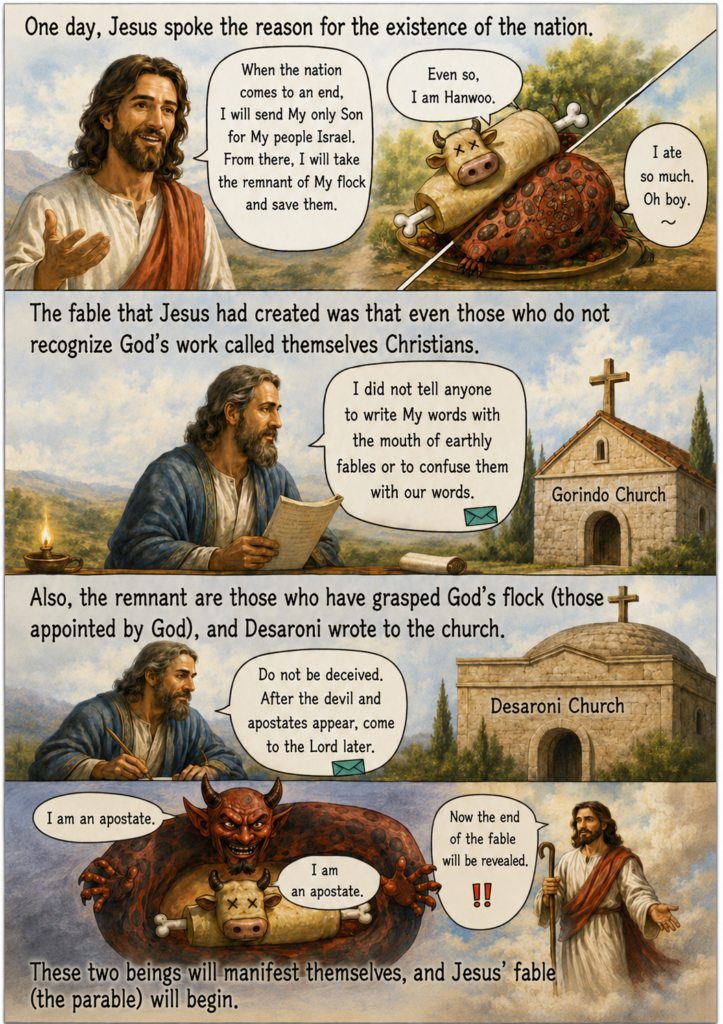
According to the author’s interpretation, the ox represents God’s appointed servant, while the fattened beast represents the destroyer who devoured God’s servant.
The reason God’s servant—the ox—was slaughtered is that he betrayed God’s covenant and departed from the faith.
Thus, in this interpretation:
- “My ox” symbolizes the betrayer, and
- “The fattened beast” symbolizes the destroyer who destroyed the betrayer.
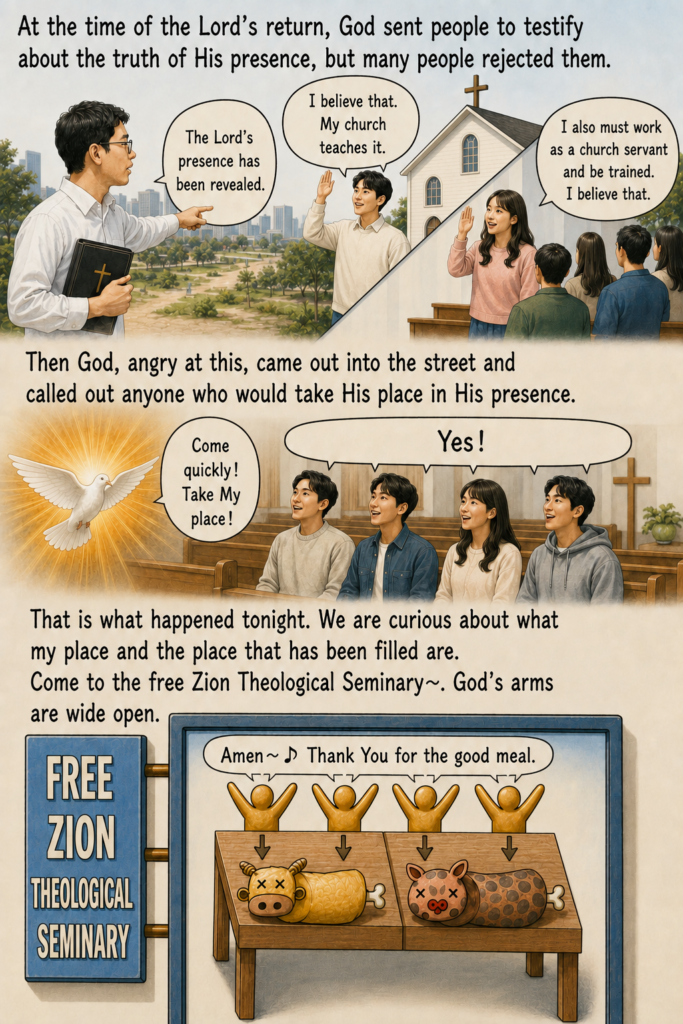
The place that reveals the true identity of these two figures is presented as the wedding banquet of heaven.
In other words, if the church to which one belongs cannot testify to the true identity of these two figures, then, according to the author’s interpretation, it is not the wedding banquet foretold in Scripture.
Wine, the Banquet, and the Wedding Feast
3️⃣ Wine
During His First Coming, Jesus referred to Himself as the true vine.
Wine is made from the fruit of the vine. Therefore, according to the author’s interpretation, the wine symbolizes the teachings of Jesus that come from Jesus, the true vine.
4️⃣ The Banquet
In the world, a banquet is commonly held during a wedding celebration. Likewise, according to Scripture, there is also a time when God brings about the marriage of Jesus. That occasion is the Wedding Banquet of the Lamb.
In other words, the banquet takes place when the wedding feast is held.
Just as described in Matthew 22, the banquet includes:
- Fat things (the ox and the fattened beast),
- Wine (the teachings of Jesus), and
- Everything prepared for the wedding feast.
What, then, is the wedding banquet described in the Bible?
The following explanation concludes this subject.
5️⃣ The Wedding Banquet
According to the author’s interpretation, during Jesus’ First Coming, God united Himself with Jesus.
God is Spirit, while Jesus came in the flesh. Just as many Christians today say that they have received the Holy Spirit, Jesus was with the Spirit of God.
According to this interpretation, the indwelling of the Spirit within a person is described in Scripture as a marriage.
In other words, it signifies the union of spirit and flesh.
The important point, however, is that there is not only the Holy Spirit, but also evil spirits.
Would you rather become one with the Holy Spirit, or with evil spirits?
Naturally, if one hopes to enter heaven, one must become united with the Holy Spirit.
This leads to another question:
Where does the Holy Spirit dwell, and where do evil spirits dwell?
“Another parable put he forth unto them, saying, The kingdom of heaven is like to a grain of mustard seed, which a man took, and sowed in his field: Which indeed is the least of all seeds: but when it is grown, it is the greatest among herbs, and becometh a tree, so that the birds of the air come and lodge in the branches thereof.”
— Matthew 13:31–32
This is one of the six parables about the kingdom of heaven that Jesus taught during His earthly ministry.
In summary, the kingdom of heaven is likened to a tree in whose branches the birds of the air come to dwell.
As explained previously, the birds symbolize spirits.
According to the author’s interpretation, this parable likewise represents the union of spirit and flesh.
In the Garden of Eden, there were the Tree of Life and the Tree of the Knowledge of Good and Evil.
The author interprets these as representing two different spiritual destinations:
- The Tree of Life, where the Holy Spirit dwells, and
- The Tree of the Knowledge of Good and Evil, where evil spirits dwell.
According to this interpretation, these two trees appear once again at the fulfillment of the Book of Revelation during the Lord’s Second Coming:
- The Tree of Life — identified as the Twelve Tribes, and
- The Tree of the Knowledge of Good and Evil — identified as Babylon.
Therefore, if one desires to become united with the Holy Spirit, one must find the Tree of Life.
Conversely, if one belongs to the Tree of the Knowledge of Good and Evil, the author teaches that one becomes united with evil spirits and ultimately faces judgment.
According to this interpretation, the Tree of Life refers to the Twelve Tribes of Shincheonji established at the time of the Lord’s Second Coming.
It is there, the author states, that the realities of “My ox,” “the fattened beast,” and “the wine” prepared for God’s banquet are revealed.
Those testimonies themselves constitute the banquet that God has prepared.
Summary
“And in this mountain shall the LORD of hosts make unto all people a feast of fat things, a feast of wines on the lees, of fat things full of marrow, and of wines on the lees well refined.”
— Isaiah 25:6
In conclusion, the passage may be summarized as follows according to the author’s interpretation:
God prepares a banquet on Mount Zion—identified by the author as the Tree of Life, the Twelve Tribes of Shincheonji—for all people.
At this wedding banquet are found:
- The fat things — interpreted as the realities of the betrayer and the destroyer, and
- The well-aged wine — interpreted as Jesus’ revealed word.
According to this interpretation, the place that can testify to the true identities of the betrayer and the destroyer is the very wedding banquet spoken of in the Bible.
In other words, if one hopes to become united with the Holy Spirit and enter heaven, the author encourages readers to come to this wedding banquet and personally confirm the identity of the betrayer (“My ox”) and the destroyer (“the fattened beast”).
“And he cried mightily with a strong voice, saying, Babylon the great is fallen, is fallen, and is become the habitation of devils, and the hold of every foul spirit, and a cage of every unclean and hateful bird.”
— Revelation 18:2
[According to the author’s interpretation: “the unclean and hateful birds” symbolize evil spirits, and “the habitation of devils” refers to Babylon, the place where unclean spirits gather.]
“And I saw an angel standing in the sun; and he cried with a loud voice, saying to all the birds that fly in the midst of heaven, Come and gather yourselves together unto the supper of the great God; That ye may eat the flesh of kings, and the flesh of captains, and the flesh of mighty men, and the flesh of horses, and of them that sit on them, and the flesh of all men, both free and bond, both small and great.”
— Revelation 19:17–18
[According to the author’s interpretation: the birds flying in mid-heaven symbolize the Holy Spirit, and this passage describes the gathering of those spirits at God’s great wedding banquet.]
“In the midst of the street of it, and on either side of the river, was there the tree of life, which bare twelve manner of fruits, and yielded her fruit every month: and the leaves of the tree were for the healing of the nations.”
— Revelation 22:2
[According to the author’s interpretation: the Tree of Life represents the Twelve Tribes, where the Holy Spirit dwells and where the twelve kinds of fruit are borne each month.]
Closing Scripture References
The following passages are presented by the author as supporting texts for the interpretation above.
“And he cried mightily with a strong voice, saying, Babylon the great is fallen, is fallen, and is become the habitation of devils, and the hold of every foul spirit, and a cage of every unclean and hateful bird.”
— Revelation 18:2
[Author’s Interpretation]
- Unclean and hateful birds = Evil spirits
- The place where unclean spirits gather = Babylon, the habitation of demons
“And I saw an angel standing in the sun; and he cried with a loud voice, saying to all the birds that fly in the midst of heaven, Come and gather yourselves together unto the supper of the great God; That ye may eat the flesh of kings, and the flesh of captains, and the flesh of mighty men, and the flesh of horses, and of them that sit on them, and the flesh of all men, both free and bond, both small and great.”
— Revelation 19:17–18
[Author’s Interpretation]
The birds flying in mid-heaven symbolize the Holy Spirit, and this passage is understood to describe the gathering of the Holy Spirit at God’s wedding banquet.
“In the midst of the street of it, and on either side of the river, was there the tree of life, which bare twelve manner of fruits, and yielded her fruit every month: and the leaves of the tree were for the healing of the nations.”
— Revelation 22:2
[Author’s Interpretation]
The Tree of Life represents the Twelve Tribes, where the Holy Spirit dwells and where twelve kinds of fruit are produced each month.